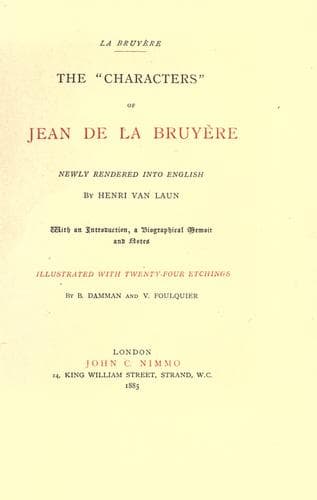
The "Characters" of Jean de La BruyèreLa Bruyère, Jean de
General
The "Characters" of Jean de La Bruyère
La Bruyère, Jean de
Character sketches -- Early works to 1800; Characters and characteristics
(94.) We meet with some men who bear with ease the weight of the royal
favour and of power, who get accustomed to their grandeur, and remain
steady though they occupy the highest posts. On the contrary, those men
whom fortune, without any choice or discrimination, has almost blindly
overwhelmed with its blessings, behave insolently and extravagantly;
their looks, their carriage, their tone of voice, and their manner
of receiving people, show for some time the admiration they have for
themselves, as well as for beholding themselves on such an eminence;
they become at last so restless that their downfall alone can tame them.
(95.) A stout and robust fellow, who has a wide chest and a broad pair
of shoulders, carries heavy burdens quickly and gracefully, and has
still one hand at liberty, while a dwarf would be crushed by half his
load. Thus eminent stations make great men yet more great, and little
ones less.
(96.) Some men gain by being eccentric; they scud along in full sail in
a sea where others are lost and dashed to pieces; they are successful
by the very means which would seem to prevent all success; they reap
from their irregularity and folly all the advantages of consummate
wisdom; they are men who devote themselves to other men, to high-born
nobles, for whom they have sacrificed everything, and in whom they
have placed their last hope; they do not serve, but amuse them.
Obsequious men of merit are useful to the great; they are necessary
to them, and grow old whilst retailing their witticisms, for which
they expect to be rewarded as if they had done some noble deeds; by
dint of being funny they obtain posts of great importance, and rise
to the highest dignities by continually buffooning, until finally and
unexpectedly they find themselves in a position they neither dreaded
nor anticipated. Nothing remains of them in this world but an example
of their success, which it would be dangerous to imitate.[559]
(97.) People might expect that certain persons who once performed
some noble and heroic actions known to the entire world, would not be
exhausted by so arduous an effort, and should at least be as rational
and judicious in their behaviour as men commonly are; that they
should be above any meanness unworthy of the great reputation they
have acquired; and that by mixing less with the people they should
not give them an opportunity of viewing them too closely, so that
curiosity and admiration might not change to indifference, and perhaps
to contempt.[560]
Public-domain text, read in full here on John Shaqi.
Reviews
Reviews
No reviews yet
Be the first to share your thoughts on this work.
Elsewhere in the archive
Join the Discussion
Join the discussion
Sign in to leave a comment or review.
Sign InorCreate an account