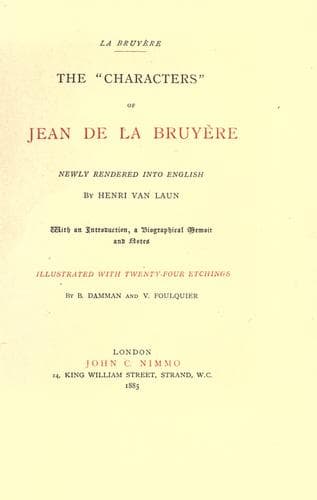
The "Characters" of Jean de La BruyèreLa Bruyère, Jean de
General
The "Characters" of Jean de La Bruyère
La Bruyère, Jean de
Character sketches -- Early works to 1800; Characters and characteristics
(103.) There are some works which begin with the first letter of the
alphabet and end with the last; good, bad, and indifferent things are
all inserted; nothing of a certain nature is forgotten; and these,
though made up of far-fetched jokes and affectations, are called
“sports of wit.”[564] The same kind of sport also rules our conduct;
a certain matter once commenced must be finished, and we have to go
on till the end. It would have been much better to alter our plan or
entirely to drop it; but it is far more odd and difficult to proceed
with it, and therefore we go on, and are stimulated by contradiction;
vanity encourages us, and takes the place of reason, which abandons and
leaves us. Such eccentricity is even carried on in the most virtuous
actions, and often in some of a religious nature.
(104.) To do our duty is an effort to us, because when we do it we
only perform our obligations, and seldom receive those eulogies which
are the greatest incentive to commendable actions, and support us in
our enterprises. N ... loves to make a display of his charity, so he
is appointed a superintendent of a charity-board, and a steward to its
revenues, whilst his house becomes a public office for the distribution
of them;[565] his doors are open to all clergymen or to Sisters of
Charity;[566] and every one sees and talks about his liberality in
relieving the poor. Who would dare to imagine N ... was not an honest
man, unless it were his creditors?
(105.) Géronte dies of mere decrepitude, and without having made the
will he intended to make for those last thirty years; as he died
intestate, about half a score of relatives share his estate among them.
For a long time he was only kept alive through the care taken of him by
his wife, Asteria, who, though young, always attended on him, never let
him go out of her sight, nursed him in his old age, and at last closed
his eyes. He has not left her money enough to rid her of the necessity
of taking another old man for a husband.
(106.) When people are loth to sell or give up their posts and offices,
even when in extreme old age, it is a token they are possessed of the
notion that they are immortal; or if they think they may die, it is a
sign they love nobody but themselves.[567]
(107.) Faustus is a rake, a prodigal, a freethinker, as well as
ungrateful and passionate; yet his uncle Aurelius neither hates him nor
disinherits him.
Frontin, his other nephew, after twenty years of acknowledged honesty
and of blind complacency for the old man, never gained his favour; and
the only legacy left to him is a small pension, which Faustus, the sole
heir, has to pay him.
(108.) Hatred is so lasting and stubborn, that reconciliation on a
sick-bed certainly forebodes death.
Public-domain text, read in full here on John Shaqi.
Reviews
Reviews
No reviews yet
Be the first to share your thoughts on this work.
Elsewhere in the archive
Join the Discussion
Join the discussion
Sign in to leave a comment or review.
Sign InorCreate an account