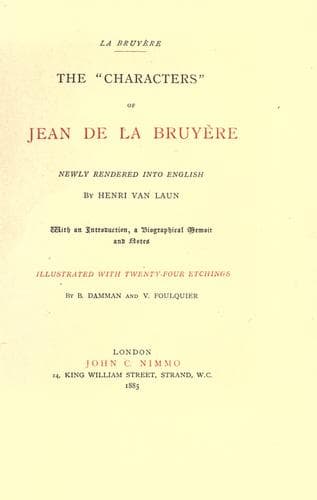
The "Characters" of Jean de La BruyèreLa Bruyère, Jean de
General
The "Characters" of Jean de La Bruyère
La Bruyère, Jean de
Character sketches -- Early works to 1800; Characters and characteristics
(98.) It is easier for some men to enrich themselves with a thousand
virtues than to correct a single vice; it is unfortunate for them that
this vice is often the least suitable to their condition in life,
and renders them highly ridiculous; it weakens their splendid and
grand qualities, and prevents them from becoming perfect and keeping
their reputation stainless. We do not require these men to be more
enlightened and incorruptible, more fond of order and discipline, more
assiduous in doing their duties, more zealous for the public good, or
more solemn in their deportment; we could only desire them to be less
amorous.[561]
(99.) Some men in the course of their lives alter so much in feeling
and intelligence, that we are sure to make a mistake if we judge
merely of them by what they appeared in their early youth. Some were
pious, wise, and learned, who have been spoiled by the favours fortune
bestowed on them, and are so no longer;[562] others began their lives
amidst pleasures, and devoted all their intelligence in their pursuit,
but, being no longer in favour, they now are religious, wise, and
temperate.[563] These latter commonly become great men, who may be
relied upon; their honesty has been tried by patience and adversity;
they, moreover, show great politeness, which they owe to the society
of ladies, and display in every circumstance, as well as a spirit of
order, thoughtfulness, and sometimes lofty capacities, acquired by
study and the leisure of a shattered fortune.
All menʼs misfortunes proceed from their aversion to being alone; hence
gambling, extravagance, dissipation, wine, women, ignorance, slander,
envy, and forgetfulness of what we owe to God and ourselves.
(100.) Men are sometimes unbearable to themselves; darkness and
solitude unsettle them, and throw them into a state of imaginary dread
and groundless terror; at such a time the least harm that can befall
them is a lassitude of everything.
(101.) Idleness is the mother of listlessness, and chiefly induces men
to hunt after diversions, gambling, and company. He who loves work
requires nothing else.
(102.) Most men employ the first years of their life in making the last
miserable.
Public-domain text, read in full here on John Shaqi.
Reviews
Reviews
No reviews yet
Be the first to share your thoughts on this work.
Elsewhere in the archive
Join the Discussion
Join the discussion
Sign in to leave a comment or review.
Sign InorCreate an account