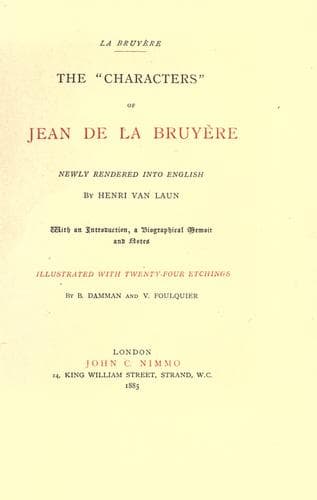
The "Characters" of Jean de La BruyèreLa Bruyère, Jean de
General
The "Characters" of Jean de La Bruyère
La Bruyère, Jean de
Character sketches -- Early works to 1800; Characters and characteristics
(158.) How many weak, effeminate, careless minds exist without any
extraordinary faults, and who yet are proper subjects for satire! How
many various kinds of ridicule are disseminated amongst the whole human
race, which by their very eccentricity are of little consequence,
and are not ameliorated by instruction or morality. Such vices are
individual and not contagious, and are rather personal than belonging
to humanity in general.
[Illustration]
XII.
OF OPINIONS.
(1.) Nothing is more like a deep-rooted conviction than obstinate
conceit; whence proceed parties, intrigues, and heresies.
(2.) We do not always let our thoughts run on one and the same subject
without varying them: infatuation[599] and disgust closely follow on
one another.
(3.) Great things astonish and small dishearten us; custom familiarises
us with both.
(4.) Two qualities quite opposed to one another equally bias our minds:
custom and novelty.
(5.) There is nothing so mean and so truly vulgar as extravagantly to
praise those very persons of whom we had but very indifferent opinions
before their promotion.
(6.) A princeʼs favour does not exclude merit, nor does it even suppose
its existence.
(7.) We are puffed up with pride and entertain a high opinion of
ourselves and of the correctness of our judgment, and yet it is
surprising we neglect to make use of it in speaking of other peopleʼs
merit; fashion, the fancy of the people or of the prince, carry us
away like a torrent; we extol rather what is praised than what is
praiseworthy.
(8.) I doubt whether anything is approved and commended more
reluctantly than what deserves most to be approved and praised; and
whether virtue, merit, beauty, good actions, and the best writings
produce a more natural and certain impression than envy, jealousy, and
antipathy. A pious person[600] does not speak well of a saint, but of
another pious person. If a handsome woman allows that another woman is
beautiful, we may safely conclude she excels her; or if a poet praises
a brother poetʼs verses, it is pretty sure they are wretched and
spiritless.
(9.) Men do not easily like one another, and are not much inclined
to commend each other. Neither actions, behaviour, thoughts, nor
expression please them nor are satisfactory; they substitute for what
is recited, told, or read to them what they themselves would have done
in such a circumstance, or what they think and have written on such a
subject; and are so full of their own ideas that they have no room for
anotherʼs.
(10.) Men are generally inclined to become dissolute and frivolous,
and such a large number of pernicious or ridiculous examples is to
be found in this world, that I should feel inclined to believe that
eccentricity, if kept within bounds and not gone too far, would almost
be like correct reasoning and regular behaviour.
Public-domain text, read in full here on John Shaqi.
Reviews
Reviews
No reviews yet
Be the first to share your thoughts on this work.
Elsewhere in the archive
Join the Discussion
Join the discussion
Sign in to leave a comment or review.
Sign InorCreate an account