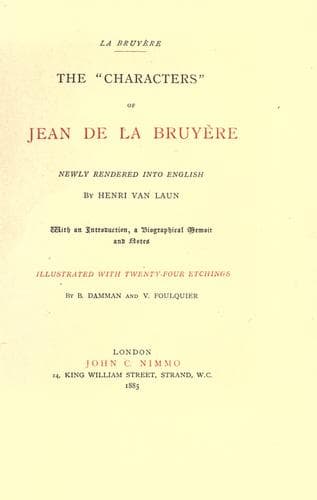
The "Characters" of Jean de La BruyèreLa Bruyère, Jean de
General
The "Characters" of Jean de La Bruyère
La Bruyère, Jean de
Character sketches -- Early works to 1800; Characters and characteristics
“We must do as others do” is a dangerous maxim, which nearly always
means “we must do wrong” if it is applied to any but external things of
no consequence, and depending on custom, fashion, or decency.
(11.) If men were not more like bears and panthers than men, if they
were honest, just to themselves and to others, what would become of
the law, the text and the prodigious amount of commentaries made on
it; what of petitions and actions,[601] and everything people call
jurisprudence? And to what would those persons be reduced who owe
all their importance and pride to the authority with which they are
invested for seeing those laws executed? If those very men were honest
and sincere, and had no prejudices, the wrangles of the schoolmen,
scholasticism, and all controversies would vanish. If all men were
temperate, chaste, and moderate, what would be the use of that
mysterious medical jargon, a gold-mine for those persons who know how
to use it? What a downfall would it be for all lawyers, doctors, and
physicians if we could all agree to become wise!
We would have been obliged to do without many men great in peace and
war. Several arts and sciences have been brought to a high degree
of exquisite perfection, which, so far from being necessary, were
introduced into the world as remedies for those evils only caused by
our wickedness.
How many things have sprung up since Varroʼs[602] times, of which he
was ignorant! Such a knowledge as Plato or Socrates possessed would now
not satisfy us.
(12.) At a sermon, a concert, or in a picture gallery, we can hear in
different parts of the room quite contrary opinions expressed upon the
very same subject; and hence I draw the conclusion that in all kinds of
works we may venture to insert bad things as well as good ones; for the
good please some and the bad others; and we do not risk much more by
putting in the very worst, for it will find admirers.
(13.) The phœnix of vocal poetry rose out of his own ashes, and in
one and the same day saw his reputation lost and recovered. That same
judge so infallible and yet so decided—I mean the public—changed his
views regarding him, and either was, or is now, in error. He who should
say to day that Q ... is a wretched poet would pronounce as bad an
opinion as he who formerly said he was a good one.[603]
(14.) Chapelain was rich and Corneille was not; _La Pucelle_ and
_Rodogune_ deserved a different fate;[604] therefore, it has always
been a question why, in certain professions, one man makes his
fortune and another fails? Men should look for the reason of this in
their own whimsical behaviour, which, on most important occasions, when
their business, their pleasures, their health, and their life are at
stake, often makes them leave what is best and take what is worst.
Public-domain text, read in full here on John Shaqi.
Reviews
Reviews
No reviews yet
Be the first to share your thoughts on this work.
Elsewhere in the archive
Join the Discussion
Join the discussion
Sign in to leave a comment or review.
Sign InorCreate an account