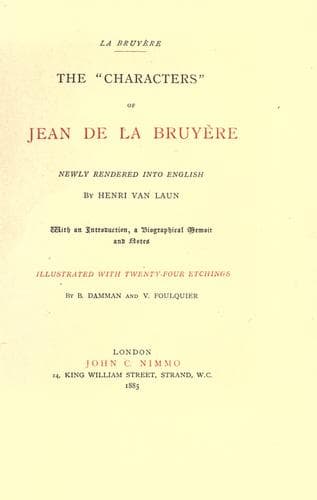
The "Characters" of Jean de La BruyèreLa Bruyère, Jean de
General
The "Characters" of Jean de La Bruyère
La Bruyère, Jean de
Character sketches -- Early works to 1800; Characters and characteristics
(19.) A politician says: “Such a man is learned, and therefore not
fit for business; I would not trust him to take an inventory of my
wardrobe;” and he is quite right, Ossat, Ximenes, and Richelieu[610]
were learned, but were they men of ability and considered able
ministers? “He understands Greek,” continues our statesman, “he is a
pedant,[611] a philosopher.” According to this argument an Athenian
fruit-woman who probably spoke Greek was a philosopher, and the Bignons
and Lamoignons[612] are mere pedants, and nobody can doubt it, for they
know Greek. How whimsical and crack-brained was the great, the wise,
and judicious Antoninus to say: “That a people would be happy whose
ruler was philosophising, or who should be governed by a philosopher or
a scribbler.”[613]
Languages are but the keys or entrance-gates of sciences, and nothing
more; he that despises the one slights the other. It matters little
whether languages are ancient or modern, dead or living, but whether
they are barbarous or polite and whether the books written in them are
good or bad. Suppose the French language should one day meet with the
fate of the Greek and Latin tongues; would it be considered pedantic to
read Molière or La Fontaine some ages after French had ceased to be a
living language?
(20.) If I mention Eurypilus, you say he is a wit.
You also call a man who shapes a beam a carpenter, and him who builds
a wall a bricklayer. Let me ask you where this wit has his workshop,
and what is his sign? Can we recognise him by his dress? What are his
tools? Is it a wedge, a hammer, an anvil? Where does he rough-hew or
shape his work, and where is it for sale? A workman is proud of his
trade; is Eurypilus proud of being a wit? If he is proud of it, he is
a coxcomb, who debases the natural dignity of his intellect, and has a
low and mechanical mind, which never seriously applies itself to what
is either lofty or intellectual; and if he is not proud of anything,
and this I understand to be his real character, then he is a sensible
and intelligent man. Do you not bestow the title of “wit” on every
pretender to learning and on every wretched poet? Do you not think you
have some intelligence, and if so, no doubt a first-rate and practical
one? But do you consider yourself, therefore, a wit, and would you not
deem it an insult to be called so? However, I give you leave to call
Eurypilus so, and this ironically, as fools do, and without the least
discrimination, or as ignorant people do who console themselves by
irony for the want of a certain culture which they perceive in others.
Public-domain text, read in full here on John Shaqi.
Reviews
Reviews
No reviews yet
Be the first to share your thoughts on this work.
Elsewhere in the archive
Join the Discussion
Join the discussion
Sign in to leave a comment or review.
Sign InorCreate an account