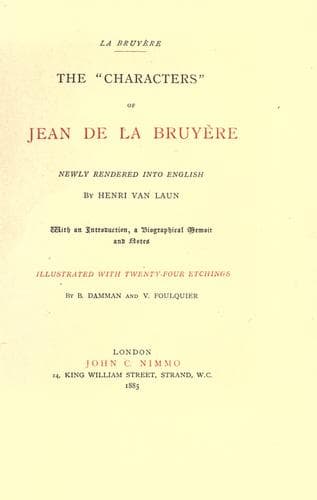
The "Characters" of Jean de La BruyèreLa Bruyère, Jean de
General
The "Characters" of Jean de La Bruyère
La Bruyère, Jean de
Character sketches -- Early works to 1800; Characters and characteristics
(86.) He who speaks little has this advantage, that he is presumed to
have some intelligence, and if he really is not deficient in it, it is
presumed to be first-rate.
(87.) To think only of ourselves and of the present time is a source of
error in politics.
(88.) Next to being convicted of a crime, it is often the greatest
misfortune for a man his being accused of having committed one, and
being obliged to clear himself from the charge. He may be acquitted
in a court of justice and yet be found guilty by the voice of the
people.[649]
(89.) One man faithfully observes certain religious duties and
discharges them carefully, yet he is neither commended nor censured, he
is not so much as thought of; another, after ten yearsʼ utter neglect
of such duties, attends again to them and is commended and extolled.
Every person has a right to his own opinion; I, for my part, blame the
second man for having so long neglected those duties, and think his
reformation fortunate for himself.
(90.) A flatterer has not a sufficiently good opinion of himself or
others.
(91.) Some men are forgotten in the distribution of favours, and we
ask what can be the reason of this; if they had not been forgotten we
should have raised the question why they had received them. Whence
proceeds this dissimilitude? Is it from the character of these persons,
or the instability of our opinions, or rather from both?
(92.) We often hear the question asked, “Who shall be chancellor,
primate,[650] pope?” People go even farther, and, according to their
own wishes or caprice, often promote persons more aged and infirm than
those who at present fill certain posts; and as there is no reason why
any post should kill its occupant, but, on the contrary, often makes
him young again, and reinvigorates his body and soul, it is not unusual
for an official personage to outlive his appointed successor.[651]
(93.) Disgrace extinguishes hatred and jealousy. As soon as a person is
no longer a favourite, and when we do not envy him any more, we admit
that his actions are good, and we can pardon in him any merit and a
good many virtues; he might even be a hero, and not vex us.
Nothing seems right that a man does who has fallen into disgrace; his
virtues and merit are slighted, misinterpreted, or called vices. If
he is courageous, dreads neither fire nor sword, and faces the enemy
with as much bravery as Bayard and Montrevel,[652] he is called a
“braggadocio,” and they make fun of him, for there is nothing of the
true hero about him.
I contradict myself; I own it; do not blame me, but blame those men
whose judgments I merely give, and who are the very same persons,
though they differ so much and are so variable in their opinions.
Public-domain text, read in full here on John Shaqi.
Reviews
Reviews
No reviews yet
Be the first to share your thoughts on this work.
Elsewhere in the archive
Join the Discussion
Join the discussion
Sign in to leave a comment or review.
Sign InorCreate an account