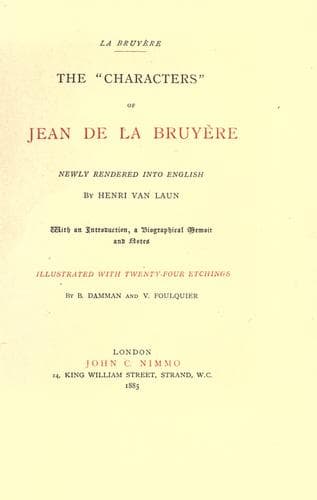
The "Characters" of Jean de La BruyèreLa Bruyère, Jean de
General
The "Characters" of Jean de La Bruyère
La Bruyère, Jean de
Character sketches -- Early works to 1800; Characters and characteristics
(77.) This favourite has been wonderfully fortunate during his whole
lifetime; he enjoyed an uninterrupted good fortune, was never in
disgrace, occupied the highest posts, was in the kingʼs confidence,
had vast treasures, perfect health, and died quietly. But what an
extraordinary account he will have to render of a life spent as a
favourite, of advice given, of advice which was not tendered or not
listened to, of good deeds omitted, and, on the contrary, of evil ones
committed, either by himself or his instruments; in a word, of all his
prosperity.[645]
(78.) When we are dead we are praised by those who survive us, though
we frequently have no other merit than that of being no longer alive;
the same commendations serve then for Cato and for Piso.[646]
“There is a report that Piso is dead; it is a great loss; he was
an honest man, who deserved to live longer; he was intelligent and
agreeable, resolute and courageous, to be depended upon, generous and
faithful;” add: “provided he be really dead.”
(79.) The way in which we exclaim about certain persons being
distinguished for their good faith, disinterestedness, and honesty is
not so much to their praise as to the disrepute of all mankind.
(80.) A certain person relieves the necessitous, but neglects his own
family and leaves his son a beggar; another builds a new house though
he has not paid for the lead of the one finished ten years before; a
third makes presents and is very liberal, but ruins his creditors. I
would fain know whether pity, liberality, and magnificence can be the
virtues of a man without sense, or whether eccentricity and vanity are
not rather the causes of this want of sense.[647]
(81.) If we wish to be essentially just to others, we should be quick
and not dilatory; to let people wait is to commit an injustice.
Those persons do well, or do their duty, who do what they ought. A man
who allows the world to speak always of him in the future tense, and to
say he will do well, behaves really very badly.
(82.) People say of a great man who has two meals a day, and spends the
rest of his time in digesting what he has eaten, that he starves; all
that they mean to express by this is that he is not rich, or that his
affairs are not very prosperous; the remark about starving might be
better applied to his creditors.
(83.) The culture, good manners, and politeness of persons of either
sex, advanced in years, give me a good opinion of what we call “former
times.”[648]
(84.) Parents are over-confident in expecting too much from the good
education of their children, and commit a grievous error if they expect
nothing from it and neglect it.
(85.) Were it true, as several persons affirm, that education does
not alter the heart and constitution of man, and that in reality the
changes it produces transform nothing and are merely superficial, yet I
would still maintain that it is beneficial to him.
Public-domain text, read in full here on John Shaqi.
Reviews
Reviews
No reviews yet
Be the first to share your thoughts on this work.
Elsewhere in the archive
Join the Discussion
Join the discussion
Sign in to leave a comment or review.
Sign InorCreate an account