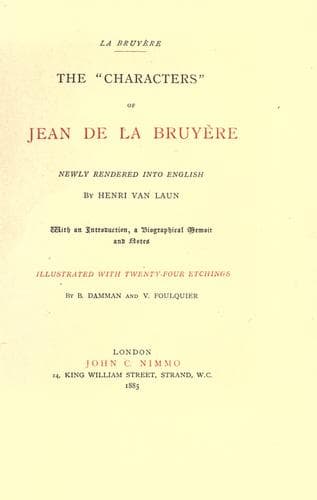
The "Characters" of Jean de La BruyèreLa Bruyère, Jean de
General
The "Characters" of Jean de La Bruyère
La Bruyère, Jean de
Character sketches -- Early works to 1800; Characters and characteristics
(15.) Those very fashions which men so willingly adopt to adorn
themselves are apt to be laid aside when their portraits are taken,
as if they felt and foresaw how crude[714] and ridiculous these would
look when they had lost the bloom and charm of novelty; they prefer
to be depicted with some fancy ornaments, some imaginary drapery,
just as it pleases the artist, and which often are as little suited
to their air and face as they recall their character and personage.
They affect strained or indecent attitudes, harsh, uncultivated, and
foreign manners, which transform a young _abbé_ into a swaggerer, and
a magistrate into a swashbuckler, a Diana into a woman of the town,
an amazon or a Pallas into a simple and timid woman, a Laïs into a
respectable girl, and a Scythian, an Attila,[715] into a just and
magnanimous prince.
Such is our giddiness, that one fashion has hardly destroyed another,
when it is driven away by a newer one, again to make way for its
successor, which will not be the last. Whilst these changes are going
on, a century elapses, and all these gewgaws are ranked amongst things
of the past, and exist no longer. Then the oldest fashion becomes again
the most elegant, and charms the eye the most, it pleases as much in
portraits as the _sagum_ or the Roman dress on the stage, as a long
black veil, an ordinary veil, and a tiara[716] do on our hangings and
our pictures.
Our fathers have transmitted to us the history of their lives as well
as a knowledge of their dresses, their arms,[717] and their favourite
ornaments; a benefit for which we can make no other return than by
doing our posterity the same service.
(16.) Formerly a courtier wore his own hair, breeches, and doublet, as
well as large canions,[718] and was a freethinker;[719] but this is no
longer becoming; now he wears a wig, a tight suit, plain stockings,
and is devout. All this because it is the fashion.
(17.) Any man who, after having dwelt for a considerable time at court,
remains devout, and contrary to all reason, narrowly escapes being
thought ridiculous, can never flatter himself with becoming the fashion.
(18.) What will not a courtier do for the sake of advancing his
interests? Rather than not advance them he will turn pious.[720]
(19.) The colours are all prepared, and the canvas is stretched, but
how shall I fix this restless, giddy, and variable man, who adopts so
many thousand different shapes? I depict him as devout, and I think
I have caught his likeness; but I have missed it, and he is already
a freethinker. Let him remain even in this bad position, and I shall
succeed in portraying his irregularity of heart and mind so that he
will be known; but another fashion is in vogue, and again he becomes
devout.
(20.) A man who thoroughly knows the court is well aware what virtue
and what piety is;[721] there is no imposing upon him.
Public-domain text, read in full here on John Shaqi.
Reviews
Reviews
No reviews yet
Be the first to share your thoughts on this work.
Elsewhere in the archive
Join the Discussion
Join the discussion
Sign in to leave a comment or review.
Sign InorCreate an account