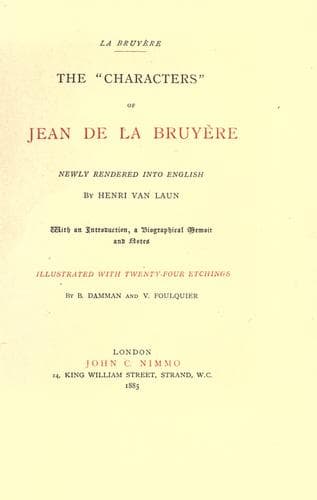
The "Characters" of Jean de La BruyèreLa Bruyère, Jean de
General
The "Characters" of Jean de La Bruyère
La Bruyère, Jean de
Character sketches -- Early works to 1800; Characters and characteristics
(28.) Already in ancient times courts granted pensions and bestowed
favours on musicians, dancing-masters, buffoons, flute-players,
flatterers, and sycophants; they possess undoubted merits, and their
talents are recognised and well known, for they amuse the great and
give them a little breathing-time during the intervals of grandeur. It
is well known that Fabien is a fine dancer, and that Lorenzani[744]
composes beautiful anthems; but who can tell if a pious man be really
virtuous? There is no pension to be got for him from the kingʼs
private purse, nor from the public treasury; and this is quite right,
for piety is easy to counterfeit; and if it were rewarded, it would
expose the prince to honour dissimulation and knavery, and to pension a
hypocrite.
(29.) It is to be hoped the piety of the court, such as it is, will at
least oblige prelates to reside in their dioceses.[745]
(30.) I am convinced that true piety is the source from which repose
flows; it renders life bearable and death without sting; hypocrisy does
not possess such advantages.
(31.) Every hour in itself, and in respect to us, is unique; when once
it is gone, it is entirely lost, and millions of ages will not bring it
back again; days, months, and years, are swallowed up and irrevocably
lost in the abyss of time; time itself shall be destroyed; it is but a
point in the immense space of eternity, and will be erased. There are
several slight and frivolous periods of time which are unstable, pass
away, and may be called fashions, such as grandeur, favour, riches,
power, authority, independence, pleasure, joy and superfluities. What
will become of such fashions when time itself shall have disappeared?
Virtue alone, now so little in fashion, will last longer than time.
[Illustration]
XIV.
OF CERTAIN CUSTOMS.
(1.) Certain people want a fortune to become ennobled.[746]
Some of these would have been ennobled[747] if they could have put off
their creditors half a year longer.
Others, again, are commoners when they lay down, and rise noblemen.[748]
How many noblemen are there whose relatives are commoners?
(2.) Some man disowns his father, who is known to keep an office or a
shop, and only mentions his grandfather, who has been dead this long
time, is unknown and cannot be found now; he enjoys a large income,
has a grand post, great connections, and wants nothing but a title to
become a nobleman.
Public-domain text, read in full here on John Shaqi.
Reviews
Reviews
No reviews yet
Be the first to share your thoughts on this work.
Elsewhere in the archive
Join the Discussion
Join the discussion
Sign in to leave a comment or review.
Sign InorCreate an account