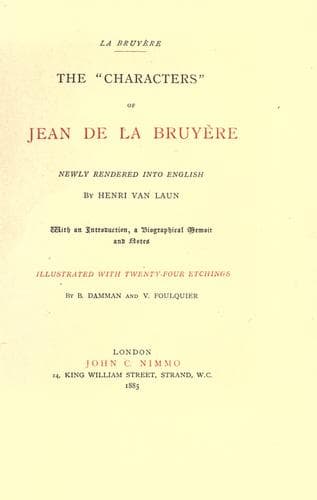
The "Characters" of Jean de La BruyèreLa Bruyère, Jean de
General
The "Characters" of Jean de La Bruyère
La Bruyère, Jean de
Character sketches -- Early works to 1800; Characters and characteristics
(3.) Formerly the words “granting letters of nobility” were considered
good French and habitually employed, but now they have become
antiquated and out of date, and the courts of justice use the word
“rehabilitation.”[749] To rehabilitate supposes a wealthy man to be
of noble descent,—for it is absolutely requisite he should be so,—and
also his father to have forfeited the title by ploughing, digging, by
becoming a pedlar, or by having been a lackey; it also supposes that
the son only desires to be restored to the rights of his ancestors, and
to wear the coat of arms his family always wore, though, perhaps, one
of his own invention, and quite different from that on his old pewter
ware; thus the granting of letters of nobility does not apply to his
case, for they only confer an honour on a commoner, that is, on a man
who has not yet discovered the secret of becoming rich.
(4.) A man of the people, by often affirming he was present when some
prodigy happened, persuades himself that he has really seen it;
another person, by concealing his age, comes to believe at last he is
as young as he would be thought; and thus a commoner, who habitually
asserts he is descended from some ancient baron, or from some noble
lord, has the ideal pleasure of fancying himself of such illustrious
descent.
(5.) What man is there, however meanly born, who having acquired some
fortune, can be in want of a coat of arms, and with this coat, heraldic
devices of the highest rank, a crest, supporters, a motto, and perhaps
a war-cry? What is become of the distinction between head-pieces and
helmets? They are no longer in use and not even mentioned; it does no
more matter if they are worn in front or profile, open or closed, and
with more or less bars; such niceties are out of date; coronets are
worn, which is far simpler, for people think they deserve wearing them,
and, therefore, bestow them on themselves. Some of the better sort of
citizens have still a little shamefacedness left which prevents them
using the coronet of a marquess, and they content themselves with an
earlʼs, whilst a few do not even go a long way for their coat of arms,
but take it from their signboards to put it on their carriages.[750]
(6.) Provided a person is not born in a city, but in some lonely
thatched house in the country, or in some ruins in the midst of
marshes, dignified with the name of castle, he will be taken for a
nobleman upon his own affirmation.
(7.) A man of noble descent wishes to pass for a small lord, and he
compasses his end; a great lord pretends to be a prince, and employs so
many precautions that, thanks to some fine appellations, quarrels about
rank and precedence, and a genealogy not recognised by DʼHozier,[751]
he at last is allowed to be a petty prince.
Public-domain text, read in full here on John Shaqi.
Reviews
Reviews
No reviews yet
Be the first to share your thoughts on this work.
Elsewhere in the archive
Join the Discussion
Join the discussion
Sign in to leave a comment or review.
Sign InorCreate an account