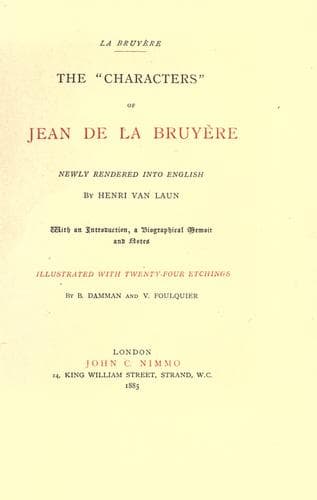
The "Characters" of Jean de La BruyèreLa Bruyère, Jean de
General
The "Characters" of Jean de La Bruyère
La Bruyère, Jean de
Character sketches -- Early works to 1800; Characters and characteristics
(8.) In everything great men mould themselves, and follow the example
of people of higher rank, who, on their side, that they may have
nothing in common with their inferiors, willingly abandon all honorific
appellations and distinctions with which their rank is burdened, and
instead of their slavery prefer a life of more freedom and ease.[752]
Those who follow their steps vie already to observe the same simplicity
and modesty. And thus, through a feeling of pride, all will condescend
to live naturally and as the people do. How horribly inconvenient they
must feel!
(9.) Some people are so fond of names that they have three for fear
of wanting some; one for the country, another for the town, and a
third which they use when on duty or in their office; others have a
dissyllabic name which they ennoble by the particle “du” or “de” as
soon as their circumstances improve; some, again, by suppressing a
syllable make a name illustrious which was before obscure; by changing
one letter of his name another person disguises himself, and he who
formerly was Syrus becomes Cyrus.[753] Many suppress their whole names,
though far from ignominious, to adopt others which sound better, and by
which they get nothing but to be always compared to the great men from
whom those names are borrowed. Finally, there are some, who, though
born within the walls of Paris, pretend to be Flemish or Italian, as if
every country had not its commoners, lengthen their French names, and
give them a foreign termination, as if names were the better for being
far-fetched.[754]
(10.) The want of money has reconciled the nobility to the commoners,
and put an end to all disputes about the quartering of escutcheons.[755]
(11.) How many persons would be gainers by a law which should decree
that nobility can be inherited from the motherʼs side, but how many
more would be losers by it.[756]
(12.) There are few families but who are related to the greatest
princes as well as to the common people.
(13.) There is nothing lost by being a nobleman; those who have a
title neither want franchises, immunities, exemptions, privileges. Do
you think it was purely for the pleasure of being ennobled that certain
monks have obtained a title? They are not so foolish; it is only for
the advantages they receive from it. It is, after all, much better than
to get money by having an interest in farming the salt tax, and that
not alone for every individual of the community, for it is against
their vows, but even for the community itself.[757]
(14.) I here declare openly and desire all men to take notice of it,
that none may hereafter be surprised: if ever any great man will think
me worthy of his patronage, if ever I happen to make my fortune, I
then shall claim descent from a certain Godfrey de la Bruyère, whom
all chronicles of France mention as one of the many French noblemen of
the highest rank who followed Godfrey of Bouillon to conquer the Holy
Land.[758]
Public-domain text, read in full here on John Shaqi.
Reviews
Reviews
No reviews yet
Be the first to share your thoughts on this work.
Elsewhere in the archive
Join the Discussion
Join the discussion
Sign in to leave a comment or review.
Sign InorCreate an account