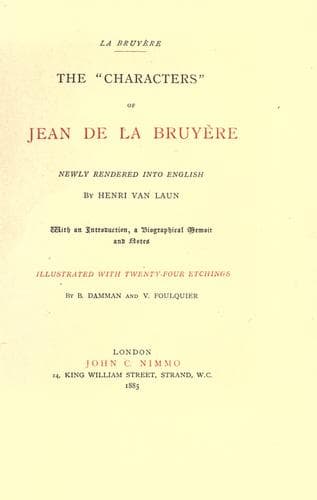
The "Characters" of Jean de La BruyèreLa Bruyère, Jean de
General
The "Characters" of Jean de La Bruyère
La Bruyère, Jean de
Character sketches -- Early works to 1800; Characters and characteristics
(40.) You have a silver coin, or even a gold coin in your possession,
but that is not enough, for such coins only exercise their influence in
large quantities; collect, if you can, a goodly number of them, make a
heap of them, and then leave the rest to me. You are neither well-born,
intelligent, talented, nor experienced, but what does it matter? only
keep up your heap and I will take care to place you in such an eminent
position that you shall stand covered before your master, if you have
one; and he must be a very great man indeed, if, with the help of your
daily increasing coin, I do not make him stand bareheaded in your
presence.
(41.) Oranta has been at law these ten years to know in what court
her cause is to be tried; her pretensions are well founded, of great
importance, and her whole fortune is at stake. Perhaps about five years
hence she may know who her judges are to be, and in what court she is
to plead for the remaining years of her life.
(42.) The custom which has, of late, been adopted by our courts of
judicature, of interrupting barristers whilst speaking, of preventing
them from being eloquent and witty, of making them go back to the mere
facts of a case, and to the bare proofs on which their clients base
their rights, is very much approved of.[778] This harsh measure, which
makes orators regret they have to leave out the finest parts of their
speeches, banishes eloquence from the only spot where it is not out of
place, and will make of our Parliaments[779] mute judicial tribunals,
is founded on this sound and unanswerable argument, that it expedites
the dispatch of business. I also wish the clerks would not forget to
accelerate their business in the same way it is now done in court, and
that not only barristersʼ speeches but the reports in writing might be
curtailed.[780]
(43.) It is the duty of a judge to administer justice, but it is his
profession to delay it; some judges know their duty and practise their
profession.
(44.) Whenever a judge is solicited[781] it reflects no credit on him,
for either his knowledge or his honesty is considered doubtful, and an
attempt is made to prejudice him or to get him to commit an injustice.
(45.) With certain judges court favour, authority, friendship, and
family connections, damage a good cause, and an affectation of wishing
to appear incorruptible induces them to become unjust.
(46.) A magistrate who is either a dandy or a gallant has a far worse
influence than if he were a dissolute man, for the latter conceals his
behaviour and intrigues, so that often it is not known how to approach
him, whilst the former with many professed foibles may be influenced by
every woman he wishes to please.
Public-domain text, read in full here on John Shaqi.
Reviews
Reviews
No reviews yet
Be the first to share your thoughts on this work.
Elsewhere in the archive
Join the Discussion
Join the discussion
Sign in to leave a comment or review.
Sign InorCreate an account