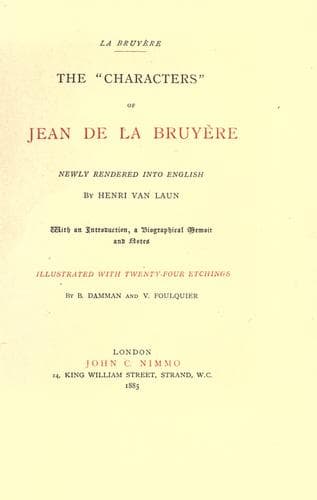
The "Characters" of Jean de La BruyèreLa Bruyère, Jean de
General
The "Characters" of Jean de La Bruyère
La Bruyère, Jean de
Character sketches -- Early works to 1800; Characters and characteristics
(47.) Religion and justice are almost alike respected in a
commonwealth, and the character of a magistrate is considered nearly
as sacred as that of a priest. A legal dignitary can hardly dance at
a ball, be seen in a theatre, or doff his plain and modest apparel,
without bringing contempt upon himself; it is strange a law should be
necessary to regulate his outward appearance, and compel him to assume
a grave and highly respectable air.[782]
(48.) There exists no profession in which an apprenticeship is
not necessary; and in considering the various stations of men, it
is manifest that, from the highest to the lowest, some time has
been allowed to every person for qualifying himself by practice
and experience for his profession, when his errors have been of no
importance, but, on the contrary, led to perfection. War itself, which
seems to owe its origin to confusion and disorder, and to be fostered
by them, has its own rules; people do not destroy one another in the
open field, in platoons, and in bands, without having been taught it,
for killing is practised methodically. There is a school for military
men; then why should magistrates not have one? There are established
practices, laws, and customs, but no time is allowed, or at least not
sufficient time, for digesting and studying them. The first attempt and
apprenticeship of a youth who, fresh from school, dons red garments,
and has been made a judge on account of his money,[783] is to decide
arbitrarily of the lives and fortunes of men.[784]
(49.) The chief qualification of an orator is probity; without it he is
no more than a declaimer, and disguises or exaggerates matters of fact,
makes use of falsified quotations, slanders, adopts all the injustice
and malice of his client, and may be ranked among those advocates of
whom the proverb says, “that they are hired to insult people.”[785]
(50.) I have heard it said: “It is true I owe a certain sum to such and
such a person, and his claim is indisputable; but I wait to see if he
will execute a small matter of form, and if he omits it, he can never
retrieve his error; consequently he will then lose his debt, and his
claim will be undoubtedly superseded. Now, he is pretty sure to forget
it!” The man who utters such words has a real pettifoggerʼs conscience.
An excellent, useful, sensible, wise, and just maxim for all courts of
judicature would be the reverse of that which prefers form to equity.
(51.) Torture is an admirable invention, and infallibly destroys an
innocent man who has a weak constitution, whilst it saves a guilty man
who is hardy.[786]
(52.) The punishment of a villain is an example for his fellows; in the
condemnation of an innocent man all honest men are concerned.[787]
Speaking of myself, I would almost affirm never to become a thief or
murderer, but I would not be so bold as to infer that I might never be
punished as such.
Public-domain text, read in full here on John Shaqi.
Reviews
Reviews
No reviews yet
Be the first to share your thoughts on this work.
Elsewhere in the archive
Join the Discussion
Join the discussion
Sign in to leave a comment or review.
Sign InorCreate an account