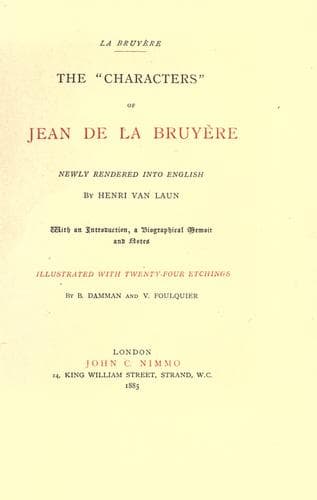
The "Characters" of Jean de La BruyèreLa Bruyère, Jean de
General
The "Characters" of Jean de La Bruyère
La Bruyère, Jean de
Character sketches -- Early works to 1800; Characters and characteristics
(60.) Does not the law, in forbidding to kill, include also stabbing,
poisoning, burning, drowning, lying in ambush, open violence, in a
word, and all means tending to homicide? Does the law, which restrains
husbands and wives from bequeathing property to one another, only refer
to direct and immediate ways of giving?[794] Has it made no provision
against those that are indirect? Was it the cause of the introduction
of trustees, and does it even tolerate them? When the dearest of wives
outlives her husband, does a man bequeath his estate to a trusty friend
as an acknowledgment of his friendship, or is it not rather a proof
of his complete confidence and reliance on that friend who will make
a right use of what has been intrusted to him? Will a man make over
his estate to anyone whom he even suspects of not restoring it to the
person for whom it is really intended? Is any speech or any letter
needed, and is a contract or an oath necessary for such a collusion?
Does not every man on such an occasion feel what he can expect from
another man? If, on the contrary, the property of such an estate is
vested in a trustee, why does he lose his reputation by retaining it?
What, then, is the reason of all these satires and lampoons?[795]
Why is he compared to a guardian who betrays his trust, to a servant
robbing his master of a sum of money he has to take somewhere? Such a
comparison is wrong. Is it considered infamous not to perform a piece
of liberality, and for a man to keep for his own use what is his own?
How strangely perplexed, how terribly burdened, must such a trustee
feel! If a man, out of respect for the laws, appropriates to himself a
trust, he can no longer be thought an honest man; if, out of love for a
deceased friend, he fulfils his intentions, and restores to the widow
what has been intrusted to him, he lends his name, and transgresses
the law. The law, then, does not harmonise with the opinions of men.
Perhaps so, but it does not suit me to say whether the law is wrong or
whether the people are mistaken.
(61.) I have been told that certain individuals or certain bodies of
men contest with one another for precedence, and that presidents of
Parliaments[796] and peers dispute as to who shall go first. In my
opinion either of the contending parties who avoids appearing when
Parliament meets, yields, is conscious of its own weakness, and decides
in favour of its competitors.
(62.) Typhon supplies a certain nobleman of high rank with horses,
dogs, and everything. On the strength of that lordʼs protection he
behaves most audaciously, and does what he likes in his own province,
without fear of being punished; he becomes a murderer, perjures
himself, sets fire to his neighboursʼ houses, and needs not look for a
refuge. At last the prince is obliged to punish him himself.[797]
Public-domain text, read in full here on John Shaqi.
Reviews
Reviews
No reviews yet
Be the first to share your thoughts on this work.
Elsewhere in the archive
Join the Discussion
Join the discussion
Sign in to leave a comment or review.
Sign InorCreate an account