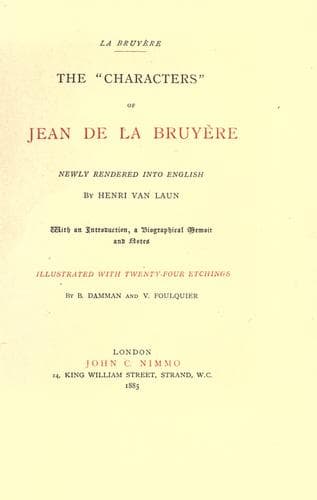
The "Characters" of Jean de La BruyèreLa Bruyère, Jean de
General
The "Characters" of Jean de La Bruyère
La Bruyère, Jean de
Character sketches -- Early works to 1800; Characters and characteristics
(58.) If there were no wills to regulate the rights of lawful heirs,
I question whether men would need any tribunal to adjust their
differences; the functions of a judge would almost be reduced to the
sad necessity of sending thieves and incendiaries[790] to the gallows.
Whom do you see in the galleries[791] of the court, in the
waiting-rooms, at the doors or in the rooms of the magistrates? Not
heirs-at-law, for their rights are immutable; but legatees, going to
law about the meaning of a clause or an article; disinherited persons
who find fault with a will drawn up at leisure and with circumspection
by a grave, able, and conscientious man, and not without the aid of
a good lawyer; with a deed in which some cunning legal practitioner
has not omitted an iota of his professional cant and his ordinary
subtleties, signed by the testator and public witnesses, duly
initialled, and which, notwithstanding all this, is set aside by the
court and declared null and void.
(59.) Titius is present at the reading of a will; his eyes are red with
weeping, and he is overcome with grief for the loss of a friend whose
heir he expects to become. One clause of the will bequeaths him his
friendʼs official position, another his municipal bonds, by a third
he becomes master of an estate in the country, and a fourth gives him
a furnished house in the middle of town, with all its appurtenances.
His grief increases, his tears flow abundantly, and he cannot contain
himself; he already beholds himself in an official position,[792] with
a town and country house, both furnished in the same style; he intends
to keep a good table and a carriage. “Was there ever a more gentlemanly
or a better man than the deceased?” he asks. But a codicil is joined
to the will which must also be read, by which Mævius is appointed sole
heir, and Titius is sent back to the suburbs to trudge without money
or titles. Titius wipes away his tears, and it is now Mæviusʼ duty to
grieve.[793]
Public-domain text, read in full here on John Shaqi.
Reviews
Reviews
No reviews yet
Be the first to share your thoughts on this work.
Elsewhere in the archive
Join the Discussion
Join the discussion
Sign in to leave a comment or review.
Sign InorCreate an account