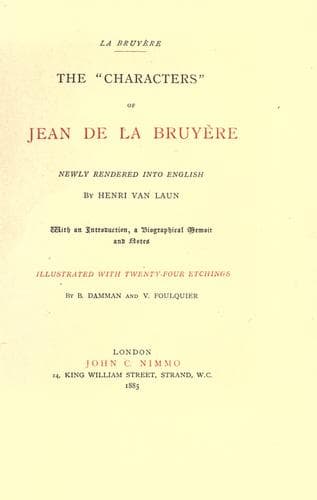
The "Characters" of Jean de La BruyèreLa Bruyère, Jean de
General
The "Characters" of Jean de La Bruyère
La Bruyère, Jean de
Character sketches -- Early works to 1800; Characters and characteristics
_Ains_ is lost; the vowel beginning it, and which could so easily be
cut off, could not save it; it gave way to another monosyllable which
at best is but its anagram.[817] _Certes_ is beautiful in its old age,
and has yet strength, though declining; it should be used in poetry,
and our language is under some obligation to those authors who employ
it in prose and defend it in their works. _Maint_ is a word which
should never have been forsaken, and on account of its adaptability for
any style and for the sake of its French origin.[818] _Moult_, though
descended from the Latin, possessed in its time the same merit, and I
do not see why _beaucoup_ should be preferred to it. _Car_ has endured
some persecution, and if it had not been protected by some men of
culture, it would have been shamefully banished from a language which
it had served so long; and this without knowing what word to put in
its place.[819] When _cil_ was in fashion it was one of the prettiest
words of the French language; and it is a sad thing for the poets that
it has become antiquated. _Douloureux_ is, of course, derived from
_douleur_, and so are _chaleureux_ or _chaloureux_ from _chaleur_: yet
_chaloureux_ is going out,[820] though it enriched our tongue, and was
employed quite correctly when _chaud_ was not the right expression.
_Valeur_ ought also to have given us _valeureux_; _haine, haineux_;
_peine, peineux_; _fruit, fructueux_; _pitié, piteux_; _joie, jovial_;
_foi, féal_; _cour, courtois_; _gîte, gisant_; _haleine, halené_;
_vanterie, vantard_; _mensonge, mensonger_; _coutume, coutumier_;
just as _part_ should have produced _partial_; _point, pointu_ and
_pointilleux_; _ton, tonnant_; _son, sonore_; _frein, effréné_; _front,
effronté_; _ris, ridicule_; _loi, légal_; _cœur, cordial_; _bien,
benin_; and _mal, malicieux_. _Heur_ was allowed when _bonheur_ did
not suit; from the first arose _heureux_, which is so French and yet
exists no longer; if some poets have employed it, it is more for the
sake of the measure than from choice. _Issue_ prospers, and comes from
_issir_, no longer in existence. _Fin_ is used, but not _finer_, which
is derived from it, whilst _cesse_ and _cesser_ are still flourishing.
_Verd_ no longer gives _verdoyer_, nor _fête, fétoyer_; nor _larme,
larmoyer_; nor _deuil, se douloir_ and _se condouloir_; nor _joie,
sʼéjouir_; though it still makes _se réjouir_ and _se conjouir_, whilst
_orgueil_ gives _sʼenorgueillir_. Formerly _gent_ was used, as in _le
corps gent_; this easy word is not alone no longer in use, but it has
involved _gentil_ in its ruin. We employ _diffamé_, which proceeds from
_fame_, which is out of date, and _curieux_ is derived from _cure_,
now obsolete. It was much better to say _si que_ than _de sorte que_
or _de manière que_, _de moi_ instead of _pour moi_ or _quant à moi_;
_je sais que cʼest quʼun mal_[821] than _je sais ce que cʼest quʼun
mal_, whether you consider the Latin analogy, or the benefit we often
Public-domain text, read in full here on John Shaqi.
Reviews
Reviews
No reviews yet
Be the first to share your thoughts on this work.
Elsewhere in the archive
Join the Discussion
Join the discussion
Sign in to leave a comment or review.
Sign InorCreate an account