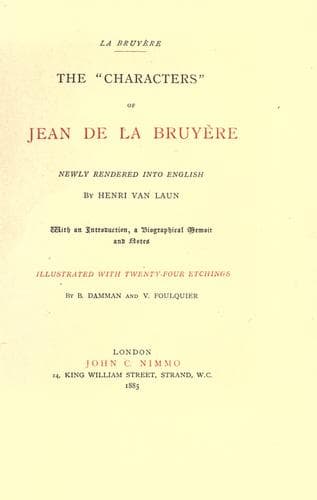
The "Characters" of Jean de La BruyèreLa Bruyère, Jean de
General
The "Characters" of Jean de La Bruyère
La Bruyère, Jean de
Character sketches -- Early works to 1800; Characters and characteristics
derive from using a word less in a phrase.[822] Custom has preferred
_par conséquent_ to _par conséquence_, and _en conséquence_ to _en
conséquent_; _façons de faire_ to _manières de faire_, and _manières
dʼagir_ to _façons dʼagir_ ...; in the verbs _travailler_ to _ouvrer_;
_être accoutumé_ to _souloir_; _convenir_ to _duire_; _faire du bruit_
to _bruire_; _injurier_ to _vilainer_; _piquer_ to _poindre_; and
_faire ressouvenir_ to _ramentevoir_ ...; and in the nouns _pensées_
to _pensers_, which is such a beautiful word and so suited for poetry;
_grandes actions_ to _prouesses_; _louanges_ to _los_; _méchanceté_
to _mauvaistié_; _porte_ to _huis_; _navire_ to _nef_; _armée_ to
_ost_; _monastère_ to _monstier_; and _prairies_ to _prées_ ...; all
words, equally fine, which might have been used together and rendered
the language more copious. Through adding, suppressing, changing, or
displacing some letters, custom has formed _frelater_ from _fralater_;
_prouver_ from _preuver_; _profit_ from _proufit_; _froment_ from
_froument_; _profil_ from _pourfil_; _provision_ from _pourveoir_;
_promener_ from _pourmener_, and _promenade_ from _pourmenade_.[823]
This same custom upon occasion makes the adjectives _habile_, _utile_,
_facile_, _docile_, _mobile_, and _fertile_ of different genders,
without changing anything in their spelling; whilst, on the contrary,
the masculine _vil_ and _subtil_ change in the feminine and become
_vile_ and _subtile_.[824] It has altered the old terminations, and of
_scel_ made _sceau_; of _mantel_, _manteau_; of _capel_, _chapeau_; of
_coutel_, _couteau_; of _hamel_, _hameau_; of _damoisel_, _damoiseau_; of
_jouvencel_, _jouvenceau_;[825] and yet all these differences and
changes have been of no perceptible advantage to the French tongue. Is
it, therefore, a progress for a language to be governed by custom, and
would it not be better to shake off the yoke of such despotic sway? Or
shall we in a living language only listen to reason, which prevents
the use of words having a double meaning, traces these words to their
roots, and discovers what relation they bear to those languages from
which they sprang, if that very reason bids us follow custom?[826]
Public-domain text, read in full here on John Shaqi.
Reviews
Reviews
No reviews yet
Be the first to share your thoughts on this work.
Elsewhere in the archive
Join the Discussion
Join the discussion
Sign in to leave a comment or review.
Sign InorCreate an account