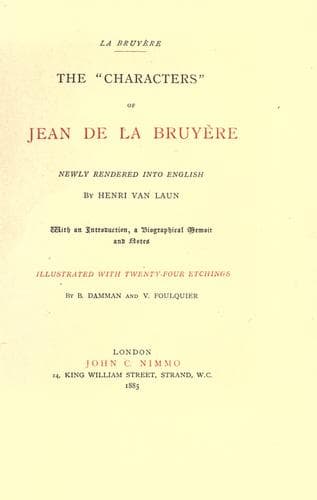
The "Characters" of Jean de La BruyèreLa Bruyère, Jean de
General
The "Characters" of Jean de La Bruyère
La Bruyère, Jean de
Character sketches -- Early works to 1800; Characters and characteristics
(16.) If you are of a certain rank, and have no other talent but
preaching dull sermons, preach away, however dull you may be, for you
will obtain no preferment if you are utterly unknown. Theodotus has
been well paid for his wretched phraseology and his tiresome monotony.
(17.) Some men have been preferred to bishopricks for their preaching,
whose talents now would not have procured them a mere prebend.
(18.) There is a certain panegyrist whose name seems always weighed
down by a heap of titles and qualities, of which a large number is
always mentioned on the ample bills distributed from house to house,
or printed in letters of enormous size on the bills stuck up in the
streets, no more to be ignored than the open market-place is. After
such a fine display if you hear that man preach, and listen for a while
to what he says, you will find that in enumerating all his qualities,
only one has been omitted, namely, that of being a wretched preacher.
(19.) The idleness of women, and the habit men have of frequenting the
places they resort to, give a certain reputation to some dull orators,
and for a while support the sinking credit of others.
(20.) Are greatness and power the only qualities which entitle a
man to be praised at his funeral before the holy altar and from the
pulpit, the seat of truth? Is there no other greatness but that derived
from an official position or from birth? Why should it not be the
custom publicly to bestow praise on a man who during his lifetime
was pre-eminent for his kindness of heart, his love of justice, his
gentleness, his fidelity, and his piety? What is called “a funeral
sermon” is now-a-days but coldly received by the greater part of the
audience, unless very different from a Christian discourse, or rather,
unless very nearly resembling a secular panegyric.
(21.) An orator preaches to get a bishopric, an apostle to save souls;
the latter deserves what the other aims at.
(22.) We see some of our clergymen[846] return from the country
where they did not stay long, as proud of having made converts, who
had already been made for them, as of those persons whom they could
not convert, compare themselves to Saint Vincent de Paul and Saint
Francis Xavier,[847] and fancy themselves apostles. For such onerous
labours and such a fortunate result of their mission they would think
themselves scarcely repaid by having an abbey given to them.
Public-domain text, read in full here on John Shaqi.
Reviews
Reviews
No reviews yet
Be the first to share your thoughts on this work.
Elsewhere in the archive
Join the Discussion
Join the discussion
Sign in to leave a comment or review.
Sign InorCreate an account