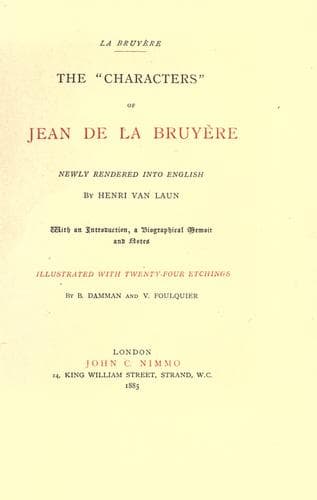
The "Characters" of Jean de La BruyèreLa Bruyère, Jean de
General
The "Characters" of Jean de La Bruyère
La Bruyère, Jean de
Character sketches -- Early works to 1800; Characters and characteristics
(21.) Certain people who have never read the fathers or doctors of the
Church are frightened at their very names, and declare their writings
dull, dry, pious, cold, and perhaps pedantic. But how astonished would
all these people be who have formed such an untrue idea of the Fathers,
if they found in their writings a better style, more delicacy, polish,
and intelligence, a greater warmth of expression and strength of
reasoning, sharper traits and more natural charms than are to be met
with in most of the modern books read by connoisseurs, which increase
the reputation and conceit of their authors. What a satisfaction to
love religion and to see men of great talent and solid learning believe
in it, assert its truth, and explain it! And whether you consider
extent of knowledge, depth and penetration, the principles of pure
philosophy, their application and development, the correctness of the
conclusions arrived at, nobleness of expression, beauty of morals and
sentiments, no profane author can be compared to Saint Augustine,
except Plato and Cicero.
(22.) Man who is born a liar cannot relish the plainness and simplicity
of truth; he is altogether hankering after appearance[862] and
ornament. He has not made truth, for it comes from Heaven ready-made,
as it were, in all its perfection, and man loves nothing but his own
productions, Fable and Fiction. Observe the common people; they will
invent a tale, add to it, and exaggerate it through coarseness or
folly; ask even the most honest man if he always speaks the truth, if
he does not sometimes discover that, either through vanity or levity,
he has disguised the truth; and if to embellish a story he does not
often add some circumstance to set it off? An accident happened to-day,
and almost, as it were, under our eyes; a hundred people have seen it,
and all relate it in as many different ways; and yet another person may
come, and if you will only listen to him, he shall tell it in a way in
which it has not yet been told. How then can I believe facts which are
so old and took place several centuries ago? What reliance can I place
on the gravest historians, and what becomes of history itself. Was
Cæsar ever murdered in the midst of the senate? and has there ever been
such a person as Cæsar? “Why do you draw such an inference?” youʼll
say; “why express such doubts and ask such questions?” You laugh, you
do not think my question worthy of an answer, and I imagine you are
quite right. But suppose the book which gives us an account of Cæsar
was not a profane history, written by men who are liars, and had not
been discovered by chance among certain manuscripts, some true, and
others suspicious; but that, on the contrary, it had been inspired, and
bore all the evidence of being holy and divine; that for nearly two
thousand years it had been kept by a large society of men, who all this
while would not allow the least alteration to be made in it, and held
Public-domain text, read in full here on John Shaqi.
Reviews
Reviews
No reviews yet
Be the first to share your thoughts on this work.
Elsewhere in the archive
Join the Discussion
Join the discussion
Sign in to leave a comment or review.
Sign InorCreate an account