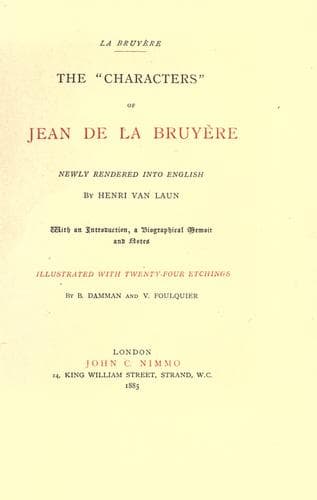
The "Characters" of Jean de La BruyèreLa Bruyère, Jean de
General
The "Characters" of Jean de La Bruyère
La Bruyère, Jean de
Character sketches -- Early works to 1800; Characters and characteristics
it as part of their creed to preserve it in all its purity; that these
men, by their own principles, were indispensably compelled to believe
religiously all the transactions related in this volume, whenever
mention was made of Cæsar and his dictatorship; own it, Lucilius, would
you then question whether there ever was such a man as Cæsar?
(23.) All kinds of music are not suited to praise God and to be heard
in the sanctuary; all methods of philosophy are not fit for discoursing
worthily of God, His power, the principles of His operations, and His
mysteries. The more abstracted and ideal this philosophy is, the more
vain and useless is it in explaining these things, which merely require
common sense to be understood up to a certain point, and which cannot
be explained farther. To pretend to give an account of the very essence
of God, of His perfections, and, if I dare say so, of His actions,
is indeed going beyond the ancient philosophers, beyond the apostles
themselves, and the first teachers of the Gospel, but it is not arguing
so much to the point as they did; for people may dig for a long time,
and deeply, without discovering the sources of truth. If once people
set aside such words as goodness, mercy, justice, and omnipotence,
which are apt to form in their minds such lovely and majestic ideas
of the divinity, let them afterwards strain their imagination as much
as possible, they will find nothing but dry, barren, and senseless
expressions; they must admit wild and empty thoughts, contrary to
all ordinary ideas, or, at least, subtle and ingenious thoughts, by
which their religion will be weakened according as they improve in the
knowledge of these new metaphysics.[863]
(24.) What excesses will a man not commit through his zeal for a
religion, of the truth of which he is not entirely convinced, and which
he practises so badly?
(25.) That same religion which men will defend so zealously and with so
much warmth against those of a different persuasion, they themselves
corrupt, by joining to it their own peculiar ideas; they add or take
from it numberless things, which are often very material, according
as it best suits their convenience, and remain steadfastly and firmly
attached to the form they have given it themselves. So that, though it
may be commonly said of a nation that it has but one manner of worship
and one religion, it truly and really has many religions, for almost
every individual has one of his own.
Public-domain text, read in full here on John Shaqi.
Reviews
Reviews
No reviews yet
Be the first to share your thoughts on this work.
Elsewhere in the archive
Join the Discussion
Join the discussion
Sign in to leave a comment or review.
Sign InorCreate an account