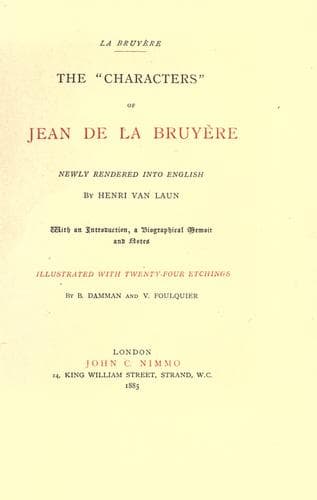
The "Characters" of Jean de La BruyèreLa Bruyère, Jean de
General
The "Characters" of Jean de La Bruyère
La Bruyère, Jean de
Character sketches -- Early works to 1800; Characters and characteristics
I exist; but perhaps this existence of mine proceeds from the power of
a universal nature, which has been ever the same, such as we behold it,
from all eternity.[868] But this nature is either only spiritual, and
then it is God, or it is material, and, consequently, could not create
that part of my being which is spiritual; or else it is composed of
spirit and matter; and then, that part of nature which people say is
spirit, is what I call God.
Again, perhaps you will add that what I call my spiritual being
is nothing but a part of matter, subsisting through the force of a
universal nature, which also is matter, which always was and ever will
be such as we see it now, and which is not God.[869] But, at least, you
must grant that what I call my spiritual being, let it be what it will,
is something which thinks, and that if it is matter, it is cogitative
matter; for no one will persuade me that, whilst I am thus arguing,
there is not something within me which thinks. Now if this something
owes its being and its preservation to a universal nature which always
was and ever will be, and which it acknowledges as its primary cause,
it necessarily follows that this universal nature either thinks, or is
more noble and perfect than that which thinks; and if such a nature
is matter, then we must come to the conclusion that it is a universal
thinking matter, or one which is nobler and more perfect than that
which does think.
I proceed further, and say, that such a supposed matter, if it be not
chimerical but real, may be perceived by some of our senses, and that,
if it cannot be discovered in itself, it may be known, at least, in
the multiple arrangement of its different parts, through which all
bodies are constituted, or differ. Therefore matter is itself all these
different bodies; now since, according to our supposition, matter is
a being which thinks, or is better than that which thinks, it follows
that it is such in some of these bodies at least, and, consequently,
that it thinks in stones, in minerals, in the earth, in the sea, in
myself, who am but a body, as well as in all its other component
parts; I am then beholden for this something, which thinks within me,
and which I call my spiritual being, to all these gross, earthly, and
corporeal parts, which all together make up this universal matter, or
this visible world, which is an absurdity.
Public-domain text, read in full here on John Shaqi.
Reviews
Reviews
No reviews yet
Be the first to share your thoughts on this work.
Elsewhere in the archive
Join the Discussion
Join the discussion
Sign in to leave a comment or review.
Sign InorCreate an account