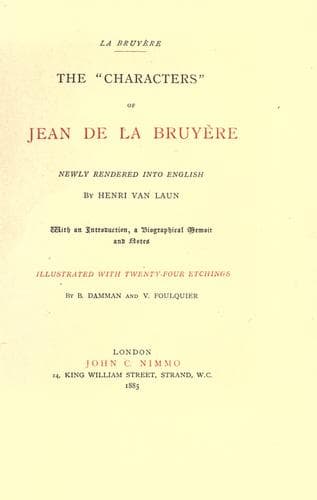
The "Characters" of Jean de La BruyèreLa Bruyère, Jean de
General
The "Characters" of Jean de La Bruyère
La Bruyère, Jean de
Character sketches -- Early works to 1800; Characters and characteristics
If, on the contrary, this universal nature, let it be what it will,
is not all these bodies, nor any of these bodies, it follows that it
is not matter, and cannot be perceived by any of our senses; and if,
notwithstanding this, it possesses the faculty of thinking, or is more
perfect than that which does think, I still conclude it is spiritual,
or something better and more perfect than spiritual. Now if that which
thinks within me, and which I call my spiritual being, not finding its
principle within itself, and much less in matter, as has been just now
demonstrated, is forced to acknowledge this universal nature to be the
first cause, the only origin of its existence, then I will not dispute
about words; but this first cause, the origin of all spiritual beings,
which is itself spiritual, or better than spiritual, is what I call God.
In a word, I think, therefore, there is a God, for that which thinks
within me is not derived from myself, since it was no more in my power
to bestow it on myself at first as it is now to keep it for one single
moment. I did not receive it from a material being superior to me,
since it is impossible for matter to be superior to that which thinks;
I must, therefore, have received it from a being superior to me, and
consequently not material; and that superior being is God.
(37.) From the inconsistency of a cogitative universal nature with
anything that is material, must necessarily be inferred, that any
particular thinking being cannot admit within itself anything
material; for though a universal thinking being does in its idea
include infinitely more grandeur, power, independence, and capacity
than a particular thinking being, yet it does not imply a greater
inconsistency with matter, it being impossible for this inconsistency
to be greater in the one case than in the other, because it is, as
it were, infinite in both; and it is as impossible for the thinking
principle within me to be matter, as it is to conceive that God should
be matter; as God, therefore, is a spirit, so my soul is also a spirit.
(38.) I am not aware whether a dog has the faculties of selection,
memory, love, fear, imagination, and thought. When, therefore, I am
told that those actions in a dog are not the effect of either passion
or sentiment, but proceed naturally and necessarily from a mechanical
disposition caused by the multiple organization of the material parts
of his body, I may, perhaps, acquiesce in this doctrine. But as for
me, I think, and certainly know that I think.[870] Now, if we consider
any organisation of material parts, namely, any space with all its
dimensions, length, breadth, and depth, and which can be divided in all
these directions, what proportion is there between such a space and
cogitation?
Public-domain text, read in full here on John Shaqi.
Reviews
Reviews
No reviews yet
Be the first to share your thoughts on this work.
Elsewhere in the archive
Join the Discussion
Join the discussion
Sign in to leave a comment or review.
Sign InorCreate an account