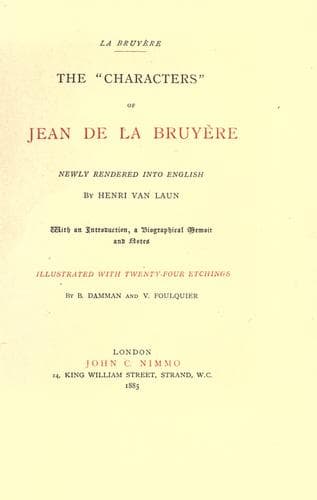
The "Characters" of Jean de La BruyèreLa Bruyère, Jean de
General
The "Characters" of Jean de La Bruyère
La Bruyère, Jean de
Character sketches -- Early works to 1800; Characters and characteristics
Nay, I will ask you what is chance? Is it a body? Is it a spirit? Is
it a being distinguished from all other beings, having a peculiar
existence or dwelling in any place; or, rather, is it not a mode or
fashion of being? When a ball rolls against a stone, we are apt to say
it is a chance; but is it anything more than an accidental hitting of
these bodies one against another? If, by this chance, or this knock,
the ball changes its straight course into an oblique one; if its motion
from direct becomes reflected; if it ceases to roll on its axis, but
winds and whirls about like a top, shall I from thence infer that
motion in general proceeds in this ball from this same chance? Shall I
not rather apprehend that the ball owes it to itself, or to the impulse
of the arm which delivered it? Or, because the circular motions of the
wheels of a clock are determined one by the other, in their degrees of
swiftness, shall I be less anxious to find out what may be the cause of
these several motions; whether it lies in the wheels themselves, or is
derived from the moving force of a weight which sets them in motion?
But neither these wheels nor this ball could produce this motion in
themselves, nor do they owe it to their own nature, if they can be
deprived of it, without changing this very nature; it is, therefore,
likely they are moved extraneously and by some power not inherent to
them. And as for the celestial bodies, if they should be deprived of
their motion, would their nature then be altered, and would they cease
being bodies? I cannot believe they would. Yet they move, and as
they move not of themselves, nor by their own nature, it behoves us,
Lucilius, to examine whether there is not some principle, not inherent
to them, which causes this motion. Whatever you may find it, I call it
God.
If we should suppose these great bodies to be without motion, we should
not then ask who moves them, but still the question would be pertinent
as to who made these bodies, as I may ask who made these wheels or that
ball? And though each of these bodies were supposed to be but a mass of
atoms, fortuitously knit together through the shape and conformation of
their parts, I should take one of these atoms, and ask: “Who created
this atom: is it matter; is it spirit; and has it any idea of itself?”
If so, then it existed a minute before it did exist; it was, and it
was not at the same time; and if it be the author of its own being,
and of its manner of being, why did it make itself a body rather than
a spirit? Moreover, has this atom had a beginning, or is it eternal,
infinite, and will you make a God of this atom?[888]
Public-domain text, read in full here on John Shaqi.
Reviews
Reviews
No reviews yet
Be the first to share your thoughts on this work.
Elsewhere in the archive
Join the Discussion
Join the discussion
Sign in to leave a comment or review.
Sign InorCreate an account