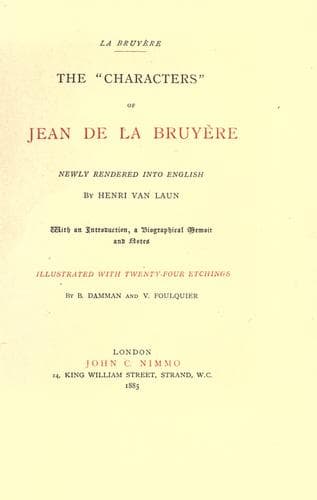
The "Characters" of Jean de La BruyèreLa Bruyère, Jean de
General
The "Characters" of Jean de La Bruyère
La Bruyère, Jean de
Character sketches -- Early works to 1800; Characters and characteristics
(44.) A mite has eyes; it turns aside if it meets objects that can
hurt it; place it on a flat piece of ebony, so that people may see it
better, and if, while it is walking, but the smallest piece of straw is
put in its way, it will alter its course immediately. Do you think its
crystalline fluid, its retina, and its optic nerve are the products of
chance?
Let pepper lie in water a little time, and be well steeped in it; then
view a single drop of it with a microscope, and an almost countless
number of animalculæ will be perceived, moving about with incredible
agility, like so many monsters in the vast ocean; each of these
animalculæ is a thousand times smaller than a mite, and yet it is a
living body, receiving nourishment, growing, having muscles, and even
vessels performing the functions of veins, nerves, and arteries, and a
brain for the distribution of its animal spirits.[889]
A speck of mould, though no bigger than a grain of sand, appears
through a microscope like a collection of many distinct plants, of
which some are plainly seen to bear flowers and other fruits; some have
buds only, partly opened, and others are withered. How extremely small
must be the roots and fibres through which these little plants receive
their nourishment! And if a person considers that these little plants
bear their own seed as well as oaks or pines, or that the animalculæ
I was speaking of are multiplied by generation as well as elephants
or whales, whither will not such observations lead? Who can have made
things so fine and so exceedingly small as to be imperceptible to the
naked eye, and which, like the heavens, border upon the infinite,
though in the other extreme? Is it not the same Being who has created,
and moves with so much facility, the heavens and the stars, those vast
bodies so terrible in their dimensions, their altitude, celerity, and
revolutions?
(45.) Man enjoys the sun, the stars, the heavens and their influences,
as much as he does the air he breathes, and the earth on which he
treads and by which he is supported. This is a matter of fact; and if
every fact were to be illustrated by fitness and verisimilitude, they
could be deduced from them, as the heavens and all they contain are not
to be compared for grandeur and dignity to one of the meanest men on
earth, there being the same proportion between them and him as there
is between matter destitute of sensation, a mere space having three
dimensions, and a spiritual, reasonable, and intelligent being.[890] If
people argue that less would have served for the preservation of man, I
reply that it is not too much to display the power, the goodness, and
the magnificence of God, as He could do infinitely more than He has
done, whatever we perceive He has done.
Public-domain text, read in full here on John Shaqi.
Reviews
Reviews
No reviews yet
Be the first to share your thoughts on this work.
Elsewhere in the archive
Join the Discussion
Join the discussion
Sign in to leave a comment or review.
Sign InorCreate an account