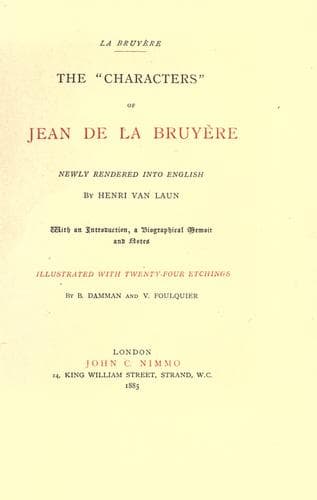
The "Characters" of Jean de La BruyèreLa Bruyère, Jean de
General
The "Characters" of Jean de La Bruyère
La Bruyère, Jean de
Character sketches -- Early works to 1800; Characters and characteristics
A certain inequality in the condition of men is conducive to the order
and welfare of the whole, is the work of God, or presupposes a divine
law; but too great a disproportion, and such as is generally seen
amongst men, is their own work, or caused by the law of the strongest.
Extremes are faulty, and proceed from men; all compensation is just,
and proceeds from God.
* * * * *
If these “CHARACTERS” are not liked, I shall be astonished; and if they
are, my astonishment will not be less.
FOOTNOTES:
[1] Pascalʼs _Pensées_ were published in 1670, six years after their
authorʼs death; La Rochefoucauldʼs _Maximes_ appeared in 1665, and
of both works from five to six editions had been sold before the
“Characters” saw the light. I have borrowed the definition of these
authorsʼ labours from La Bruyèreʼs “Prefatory Discourse concerning
Theophrastus,” which came out at the same time as the “Characters,” and
served as an introduction.
[2] Preface to La Bruyèreʼs “Characters,” page v.
[3] Preface to La Bruyèreʼs “Speech upon his Admission as a Member of
the French Academy, June 15, 1693,” which preface was published for the
first time with the eighth edition of the “Characters,” in 1694.
[4] Preface to La Bruyèreʼs “Characters,” page i.
[5] Preface to La Bruyèreʼs “Speech upon his Admission as a Member of
the French Academy, June 15, 1693.”
[6] Preface to La Bruyèreʼs “Speech upon his Admission as a Member of
the French Academy, June 15, 1693.”
[7] Sir Walter Scott, in his introduction to Drydenʼs “Absalom and
Achitophel,” says: “He who collects a gallery of portraits disclaims,
by the very act of doing so, any intention of presenting a series of
historical events.”
[8] It was the custom in Paris, at the time La Bruyère wrote, for any
gentleman or lady to leave part of their gains on the table, to pay, as
it were, for the cards; hence the allusion.
[9] All the passages on pages _15_ and _16_ between inverted commas (“ ”)
have been taken from La Bruyèreʼs “Prefatory Discourse concerning
Theophrastus.”
[10] See the Chapter “Of the Great,” page 230, § 25. When, in the
Chapter “Of Certain Customs,” page 408, § 14, he speaks of his “descent
from a certain Godfrey de la Bruyère,” he does so jocularly.
[11] Compare “Preface,” page iv., “I did not hesitate,” till page v.,
“and more regular.”
Public-domain text, read in full here on John Shaqi.
Reviews
Reviews
No reviews yet
Be the first to share your thoughts on this work.
Elsewhere in the archive
Join the Discussion
Join the discussion
Sign in to leave a comment or review.
Sign InorCreate an account