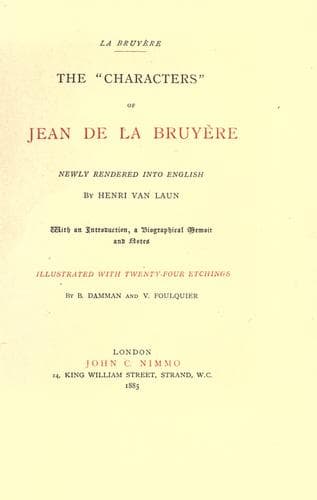
The "Characters" of Jean de La BruyèreLa Bruyère, Jean de
General
The "Characters" of Jean de La Bruyère
La Bruyère, Jean de
Character sketches -- Early works to 1800; Characters and characteristics
[12] In his “Introduction to the Reader,” printed before “Absalom and
Achitophel,” and published in 1681, Dryden openly admits: “I have laid
in for those, by rebating the satire, where justice would allow it,
from carrying too sharp an edge. They who can criticise so weakly as to
imagine I have done my worst, may be convinced at their own cost that I
can write severely with more ease than I can write gently.” La Bruyère
would never have ventured to speak so plainly, and this difference
between the French and English author seems very characteristic of the
two nations. Compare also Drydenʼs poetic delineation of Buckingham as
Zimri to La Bruyèreʼs portrait of Lauzun as Straton.
[13] Perhaps no author is more quoted in Littréʼs _Dictionnaire de la
langue française_ than La Bruyère is.
[14] M. G. Servois, in his bibliographic Notice of La Bruyèreʼs
works, &c., vol. iii., first part, quotes a passage from the London
correspondent of the _Histoire des Ouvrages des savants_ (see page
19, note 3) in affirmation of this statement, and seems to think this
translation to have been the first edition of the one mentioned in No.
4.
[15] Wattʼs “Bibliotheca Britannica.”
[16] According to M. Servois, this edition is mentioned in Lowndesʼ
“The Bibliographerʼs Manual,” but I have not been able to find it there.
[17] I imagine I can observe slight traces of La Bruyère in Swiftʼs
“Account of the Empire of Japan, written in 1728,” beginning with the
words: “Regoge was the 34th emperor of Japan;” in nearly all he wrote
for the Tatler; in many of the portraits to be found in the Examiner,
for example in the portrait of “Laurence Hyde, late earl of Rochester,”
beginning with the words: “The person who now presides at the Council,
etc.” Compare also “A Short Character of Thomas, Earl of Wharton;” the
“Narrative of Guiscardʼs Examination;” and in the “True Relation of the
Intended Riot,” the passage beginning with “the surprising generosity,
and fit of housekeeping the German princess has been guilty of this
summer.” Swift, moreover, possesses a far more trenchant style than the
French author, but I imagine the latter did as much execution, though
he used a rapier, whilst Swift employed a bludgeon.
Public-domain text, read in full here on John Shaqi.
Reviews
Reviews
No reviews yet
Be the first to share your thoughts on this work.
Elsewhere in the archive
Join the Discussion
Join the discussion
Sign in to leave a comment or review.
Sign InorCreate an account