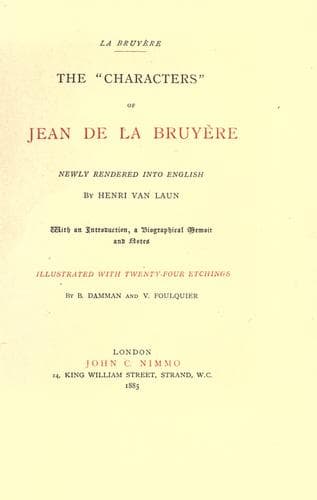
The "Characters" of Jean de La BruyèreLa Bruyère, Jean de
General
The "Characters" of Jean de La Bruyère
La Bruyère, Jean de
Character sketches -- Early works to 1800; Characters and characteristics
[18] There are few portraits in Shaftesburyʼs “Characteristics;” one of
the few exceptions being the portrait of “a notable enthusiast of the
itinerant kind,” supposed to be Van Helmont; now and then, however, he
seems to have borrowed a few ideas of La Bruyère, as for example, in
the second section of “A Letter concerning Enthusiasm,” his remarks on
criticism and ridicule. Compare also Shaftesbury in section 2, saying:
“The vulgar, indeed, may swallow any sordid jest, any mere drollery or
buffoonery; but it must be a finer and truer wit which takes the men of
sense and breeding,” to La Bruyèreʼs Chapter “Of Works of the Mind,”
§§ 51, 52; the whole of this “Letter” is somewhat like La Bruyère, as
in section iv. the crafty beggars, addressing some one they meet in a
coach, and of whose quality they are ignorant. In Shaftesburyʼs “Sensus
Communis, an Essay on the Freedom of Wit and Humour,” part 1, section
3, his remarks about true raillery; and the opening of the second
part, section 1: “If a native of Ethiopia were of a sudden transported
into Europe,” etc., as well as in the “Soliloquy,” the allegory of the
love-spent nobleman, and in the “Moralists” the portraits of Palemon,
Philocles, and Theocles, and the opening of the third part, “it was yet
deep night,” appear somewhat like reminiscences of the French author.
[19] “English Philosophers:” Shaftesbury and Hutcheson. By Thomas
Fowler, President of Corpus Christi College: London, 1882.
[20] It will, of course, be impossible to give “chapter and verse”
for every passage of the “Spectator” which is faintly like one of La
Bruyèreʼs observations, nor do I mean to say that Addison, Steele, and
the other contributors to the English paper borrowed literally, and
without acknowledgment, from the French author. But what I intended to
convey was that, though the humour of the Spectator and its Sir Roger
de Coverley, Sir Andrew Freeport, Will Honeycomb, Captain Sentry,
&c., are pre-eminently English, several of the remarks and portraits
to be found there are more or less inspired by a careful study of La
Bruyère. Compare for example Addisonʼs paper about the opera, Spectator
No. 5, to § 47 of La Bruyèreʼs Chapter “Of Works of the Mind;” and
the remarks in No. 10 of the Spectator, about the occupations of the
female world, and Nos. 144, 156, and No. 265 of the same paper, with
some paragraphs of La Bruyèreʼs Chapter “Of Women.” Nos. 45, 57,
77, 88, 98, 100, 129, 193, 236, 238, and 494, appear to me somewhat
like several of La Bruyèreʼs paragraphs. The “fair youth” in No. 104
of the “Spectator” is not unlike a reverse picture of La Bruyèreʼs
portrait of Iphis in the Chapter “Of Fashion,” page 389, § 14; whilst
the remark in No. 226, “Who is the better man for beholding the most
beautiful Venus,” &c., reminds one of La Bruyèreʼs remark on obscene
“pictures painted for certain princes of the Church,” in his Chapter
“Of Certain Customs,” page 409, § 17. Steeleʼs opinions about corporal
Public-domain text, read in full here on John Shaqi.
Reviews
Reviews
No reviews yet
Be the first to share your thoughts on this work.
Elsewhere in the archive
Join the Discussion
Join the discussion
Sign in to leave a comment or review.
Sign InorCreate an account