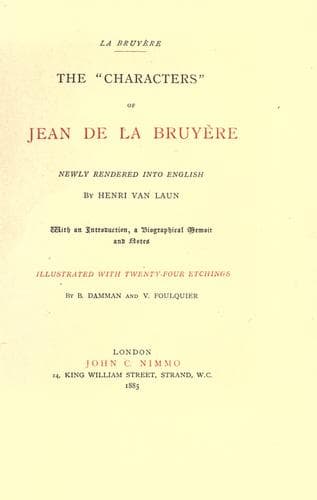
The "Characters" of Jean de La BruyèreLa Bruyère, Jean de
General
The "Characters" of Jean de La Bruyère
La Bruyère, Jean de
Character sketches -- Early works to 1800; Characters and characteristics
[40] M. de La Bruyère adopts the chronology of Suidas, a Greek
lexicographer who flourished during the latter end of the eleventh
century; according to the Hebrew chronology the world had only existed
5692 years when the “Characters” were first published in 1688.
[41] _Abile_ in the original, in the sense of the English word “able,”
and used as a noun, was already then considered antiquated.
[42] _Sentiment_, in the original, was during the seventeenth century
not seldom employed in French for “opinion,” as “sentiments” are at
present in English.
[43] This magistrate is said to have been Pierre Poncet de la Rivière,
Count dʼAblys (1600-1681), a barrister, a councillor of state, and
member of the royal council of finances, whose absurd moral treatise,
_Considérations sur les avantages de la vieillesse dans la vie
chrétienne, politique, civile, économique et solitaire_, was published
under the pseudonym of the Baron de Prelle, in the month of August
1677, about one month before the death of the Lord Chancellor dʼAligre,
and more than three months before President Lamoignonʼs decease.
[44] At that time so-called collections of anecdotes, such as
_Boléana_, _Ménagiana_, and _Segraisiana_, were greatly in vogue.
[45] It is said that the great dramatic poet Pierre Corneille
(1606-1684) is alluded to as one of those poets.
[46] All the “Keys” pretend this is a hit at the “Dictionary of the
Academy,” and they may be right; for the Dictionary, only published
in 1694, six years after the “Characters” first saw the light, had
been expected for more than forty years. But most likely La Bruyère
was thinking of the tragedy-ballet of _Psyché_ (1671), words by Pierre
Corneille and Molière, music by Quinault and Lulli; of the opera which
in 1680 Racine and Boileau, joint _historiographes_ of Louis XIV.,
began, and which never saw the light; and of the newly-acted _Idylle
sur la Paix_ and the _Eglogue de Versailles_ (1685), written by
Quinault, Racine, and Molière.
[47] Even in La Bruyèreʼs lifetime doubts were already expressed about
the Iliad being written by Homer.
[48] This Roman orator was Cicero.
[49] La Bruyère adds in a footnote: “Even merely considered as an
author.”
[50] Almost every one felt during the seventeenth century a dislike for
Gothic architecture.
[51] Probably Bernard le Bovier de Fontenelle (1657-1757) is meant
here. This author had made excellent classical studies in a Jesuit
college, but attacked the ancients in his _Discours sur LʼEglogue_ and
in his _Digression sur les anciens et les modernes_, published together
with his _Poésies Pastorales_ in 1688. The paragraph beginning “A man
feeds” and ending “nurses” was only printed for the first time in the
fourth edition of the “Characters,” published in 1689.
[52] It is generally thought that Charles Perrault (1628-1703), a
member of the French Academy, is alluded to, but this seems more than
doubtful.
Public-domain text, read in full here on John Shaqi.
Reviews
Reviews
No reviews yet
Be the first to share your thoughts on this work.
Elsewhere in the archive
Join the Discussion
Join the discussion
Sign in to leave a comment or review.
Sign InorCreate an account