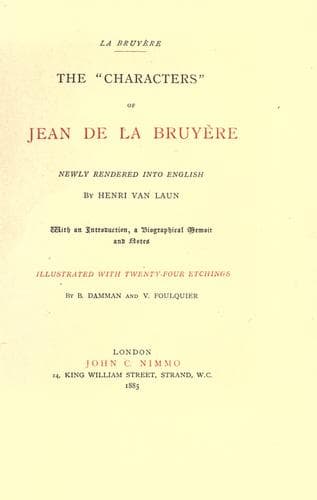
The "Characters" of Jean de La BruyèreLa Bruyère, Jean de
General
The "Characters" of Jean de La Bruyère
La Bruyère, Jean de
Character sketches -- Early works to 1800; Characters and characteristics
[53] Those “able men” were the dramatist Jean Racine (1639-1699) and
the satirist Nicolas Boileau Despréaux (1636-1711).
[54] Zoilus, a Greek grammarian, flourished about 356-336 B.C.,
and assailed Homer, Plato, Isocrates, and other Greek authors with
merciless severity.
[55] According to all the “Keys,” this is said to be an allusion to
the Abbé de Dangeau (1643-1723), a member of the French Academy, and a
brother of the better known marquis. But why and wherefore this Abbé
has been singled out, has not reached posterity. Some say the President
Cousin, the editor of the _Journal des Savants_, was meant.
[56] Ζηλωτής means “envious.”
[57] In his _Recueil de divers ouvrages en prose et en vers_, 1676,
Charles Perrault defended the _Alceste_ of Quinault and attacked the
_Alcestis_ of Euripides. Unfortunately his criticism contained several
errors, which Racine noticed in the preface of _Iphigénie_, accusing
Perrault at the same time of having carelessly read the work he was
censuring.
[58] This was meant for Henri-Joseph de Peyre, Count de Troisvilles
(1642-1708), pronounced Tréville, a very intelligent and
highly-cultivated nobleman, brought up in his youth with Louis XIV.,
whose talents he rather undervalued. He was on intimate terms with
the Port-Royalists, and after several alternate fits of devotion and
dissipation, ended his days devoutly and penitently.
[59] The Abbé de Dangeau, a pedantical purist mentioned already, page
13, note.
[60] In the seventeenth century fireworks were in French _feu gréçois_,
literally “Greek fire.”
[61] The _Cid_, the dramatic masterpiece of Pierre Corneille, was first
performed in 1636. Cardinal Richelieu tried to get up a cabal to crush
it, but was unsuccessful; he also persuaded the Academy to publish
a severe criticism on it, which is too favourably spoken of by La
Bruyère. Boileau says in his ninth satire:—
“En vain contre le Cid un ministre se ligue,
Tout Paris pour Chimère a les yeux de Rodrigue.
LʼAcadémie en corps a beau le censurer,
Le public révolté sʼobstine à lʼadmirer.”
[62] _Courageux_ and _courage_ were not seldom used in the seventeenth
century for “heartfelt” and “heart,” whilst _main dʼouvrier_, “hand of
a workman,” was sometimes employed instead of _main de maître_, “hand
of a master.”
[63] The dramatist Edme Boursault (1638-1701) had had a literary
quarrel with Boileau, who attacked him in his ninth _Satire_, to which
Boursault replied by his comedy _La Satire des Satires_. But they had
been reconciled more than a year before the “Characters” were published.
[64] Father Bouhours (1628-1702), a literary Jesuit of some reputation
and talent, published in 1689 his _Pensées ingénieuses des anciens et
des modernes_, in which he several times praised the “Characters.” La
Bruyère, not to be behind-hand, inserted the learned fatherʼs name in
his fifth edition, published in 1690.
Public-domain text, read in full here on John Shaqi.
Reviews
Reviews
No reviews yet
Be the first to share your thoughts on this work.
Elsewhere in the archive
Join the Discussion
Join the discussion
Sign in to leave a comment or review.
Sign InorCreate an account