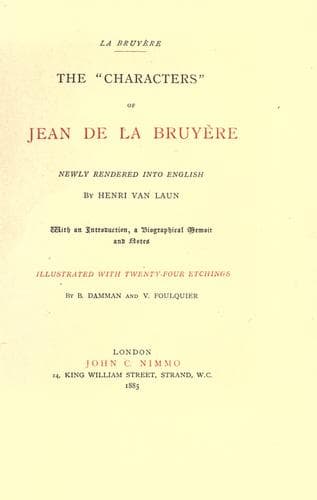
The "Characters" of Jean de La BruyèreLa Bruyère, Jean de
General
The "Characters" of Jean de La Bruyère
La Bruyère, Jean de
Character sketches -- Early works to 1800; Characters and characteristics
[77] In the original _il feint_, the Latin _fingit_, he shapes,
imagines.
[78] Ronsard (1524-1585), the chief of the “Pleiad” or constellation of
seven authors, was the most celebrated poet of his time, and the author
of the _Franciade_.
[79] Clément Marot (1495-1544), the favourite poet of Francis I., was
born twenty-nine years before Ronsard, who lived about forty years
longer than Marot.
[80] Rémy Belleau (1528-1577), Jodelle (1532-1573), and du Bartas
(1544-1590), were all poets of the school of Ronsard and belonging to
the “Pleiad.” Du Bartasʼs chief work has been translated into English
by “silver-tongued” Joshua Sylvester (1563-1618), under the title of
“The Divine Week and Works;” and Spenser speaks of “his heavenly muse,”
and of his filling “the world with never-dying fame.”
[81] Honorat de Bueil, Marquis de Racan (1589-1670), the favourite
pupil of Malherbe, is chiefly known by his pastoral dialogue, _Les
Bergeries_. La Bruyère praises Malherbe and Racan for their pure style,
but the fabulist Jean de la Fontaine says of them:—
“Malherbe avec Racan parmi le chœur des anges,
Là-haut de lʼEternel célébrant les louanges
Ont emporté leur lyre.”
[82] François Rabelais (1459-1553), author of the _Chroniques de
Gargantua et de Pantagruel_.
[83] La Bruyère writes “Montagne,” and so it is even now pronounced.
Montaigneʼs (1533-1592) “Essays” are known everywhere.
[84] The author who “thinks too little” is said to have been the
Port-Royalist, Pierre Nicole (1625-1695), though some imagine Balzac
was meant; the author who thought “with too much subtlety” seems to
have been Father Malebranche (1638-1715), who attacked Montaigne in his
_Recherche de la Vérité_ (1674).
[85] Jacques Amyot (1513-1593), the translator of Plutarch. Nicolas
Coëffeteau (1574-1623), bishop of Marseille, is best known by his
translation of the Roman historian, Florus.
[86] The letters H. G. stand for _Hermes Galant_, “Hermes” being the
Greek for Mercury, and there existing since 1672 a kind of monthly
review, called the _Mercure Galant_, edited by Donneau de Visé, Thomas
Corneille, and Fontenelle, and printing some news from the court and
the army, a few literary articles, and as many advertisements as
possible. Since 1677 its title changed to _Mercure de France_.
[87] Boileau, La Fontaine, and Saint Evremond were, like La Bruyère, no
lovers of the opera.
[88] The Abbé Perrin and his brother-in-law, the Marquis de Sourdéac,
the first regular directors of opera in France, ruined themselves
in less than three years through their expensive decorations and
machinery. In 1672 Lulli and his son-in-law Francine obtained
permission to manage another opera-house, but spent far less money on
decorations than their predecessors had done. Our author calls Lulli
“Amphion,” a Greek musician who is said to have built Thebes by the
music of his lute.
Public-domain text, read in full here on John Shaqi.
Reviews
Reviews
No reviews yet
Be the first to share your thoughts on this work.
Elsewhere in the archive
Join the Discussion
Join the discussion
Sign in to leave a comment or review.
Sign InorCreate an account