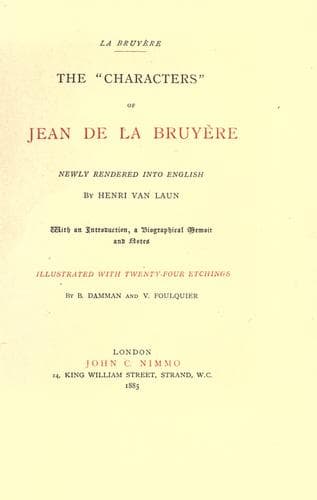
The "Characters" of Jean de La BruyèreLa Bruyère, Jean de
General
The "Characters" of Jean de La Bruyère
La Bruyère, Jean de
Character sketches -- Early works to 1800; Characters and characteristics
[65] Roger de Rabutin, Count de Bussy (1618-1693), a friend of our
author, enjoyed a certain literary reputation in the seventeenth
century, now completely lost. He is only remembered by his licentious
and satirical _Histoire amoureuse des Gaules_, for which he was
banished from the court for more than twenty years.
[66] Damis was meant for Boileau.
[67] There had been a whole family of printers of that name, though
only André was alive when the “Characters” appeared. At that time books
in France and in England were almost always sold bound.
[68] By “newsmonger” our author alludes to the manufacturers of
manuscript newspapers, containing all kinds of social and political
scandal, eagerly sought for, and who were severely punished when
caught. The English translator of 1702 gives for _nouvelliste_
“journalist,” and says in his “Key:” “The author of the Works of the
Learned of Paris,” etc. The _Histoire des Savants_, edited by H.
Basnage (1656-1710), was published in Holland. Mr. N. Rowe, in his
translation published in 1713, also uses the word “journalist,” and
says in the “Key:” “On the authors of Journals, or accounts of books
and News, published in France, Holland,” etc.
[69] La Bruyère speaks here of himself.
[70] In the seventeenth century, _bel esprit_, plural _beaux esprits_,
in the original, meant a man of intelligence, but began already in La
Bruyèreʼs time to have the meaning of “witling.”
[71] Jean Guez de Balzac (1594-1655), one of the first members of the
French Academy, wrote, besides his over-praised “Letters,” a _Socrate
Chrétien_, the _Prince_, a panegyric on Louis XIII., and _Entretiens ou
Dissertations littéraires_.
[72] Voiture (1598-1648), also a member of the French Academy, is
chiefly known by his “Letters” and some namby-pamby poetry, amongst
which is the well-known sonnet on “Uranie,” which was by many preferred
to the sonnet on “Job” by Benserade, and gave rise to a pretty literary
quarrel in the seventeenth century. Voiture and Balzac are now
deservedly buried in oblivion.
[73] The letters of Madame de Sévigné (1626-1696) were not published
until 1726, or thirty years after La Bruyèreʼs death, though perhaps he
might have seen some of them in manuscript. Among the ladies celebrated
for their epistolary style in the seventeenth century were Madame de
Maintenon, Mademoiselle de Scudéry, Madame de Bussy-Lameth, and above
all Madame de Boislandry. See the Chapter “Of Opinions,” § 28, “A
Fragment.”
[74] Publius Terentius Afer (194-158 B.C.), a celebrated Latin comic
dramatist.
[75] Some commentators on La Bruyère think that the words “vulgar
tongue (_jargon_) and barbarisms” refer to Molière having put peasants
on the stage, and letting them speak their dialect. See § 52.
[76] Malherbe (1555-1628) was one of the greatest purists amongst
the authors of his time. Théophile de Viau (1591-1626), a writer of
tragedies and a poet, was by some of his contemporaries thought to be a
rival of Malherbe.
Public-domain text, read in full here on John Shaqi.
Reviews
Reviews
No reviews yet
Be the first to share your thoughts on this work.
Elsewhere in the archive
Join the Discussion
Join the discussion
Sign in to leave a comment or review.
Sign InorCreate an account