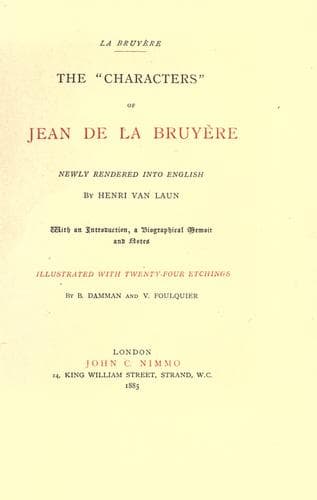
The "Characters" of Jean de La BruyèreLa Bruyère, Jean de
General
The "Characters" of Jean de La Bruyère
La Bruyère, Jean de
Character sketches -- Early works to 1800; Characters and characteristics
[124] V ... stands for Claude François Vignon (1634-1703), a son of an
artist of the same name; C ... is Pascal Colasse, a pupil of Lulli,
whose opera, _Achille et Polyxène_, was played a short time before
the “Characters” were first published (1687); _Pyrame_, written by
Pradon (1632-1698), was acted in 1674; he had brought out several other
tragedies before the first appearance of La Bruyèreʼs book. At that
time Pierre Mignard (1635-1695), the celebrated artist, and Pierre
Corneille (1606-1694) were still alive, and Lulli (1633-1687), the
great musician, had only been dead a few months.
[125] Desiderius Erasmus (1467-1536), one of the most celebrated
scholars and learned men of his time.
[126] By this bishop some say was meant M. de Harlay (1625-1695),
archbishop of Paris; others think the archbishop of Rheims, Le Tellier
(1642-1710), the brother of Louvois, was designated. See also page 141,
note 1.
[127] The original has _collier dʼordre_, the collar of the order of
the Holy Ghost.
[128] Trophime, it was supposed, stood for our authorʼs friend Bénigne
Bossuet (1627-1704), the eminent theologian, preacher, and bishop of
Meaux, but he never became a cardinal. So general was this supposition,
that in all editions of the “Characters” published after the authorʼs
death the name of “Bénigne” was put instead of “Trophime.” Some “Keys,”
however, mention the name of Etienne le Camus (1632-1707), bishop of
Grenoble, who became a cardinal in 1686.
[129] Lord Stafford is meant here; he was a relative to the Duke of
Norfolk, very rich and very eccentric, and married in 1694 a daughter
of the Count de Gramont. Some think the Count dʼAubigné, the brother of
Mdlle. de Maintenon, is spoken of.
[130] La Bruyère adds in a footnote, “an agate.”
[131] In the original _il ne se plaint non plus_. _Plaindre_ had
sometimes the meaning of “to be sparing,” and Le Sage employs it in
_Gil Blas_ in that sense.
[132] This is said to apply to a certain M. de Mennevillette,
_receveur-général_ of the clergy, whose son married Mdlle. de Harlay.
[133] In the original _drap de Hollande_, because the best cloth came
from Holland. Colbert induced some Dutch and Flemish weavers to settle
in France, where they made a cloth called _Toile Colbertine_, of which
Molière wore a doublet as the Marquis in _les Fâcheux_. Colberteen is
also mentioned in “The Fopʼs Dictionary” (1690), and in Congreveʼs “The
Way of the World.”
[134] The _lumen gloriæ_ is, according to Roman Catholic theologians,
“The help God affords to the souls of the blessed, to strengthen them
that they may be able to see God ‘face to face,’ as St. Paul says
(1 Cor. xiii. 12), or by intuition; as they say in the schools; for
without such a help they could not bear the immediate presence of God.”
[135] A certain preacher, Charles Boileau, was meant; others think it
was a canon of Notre-Dame, called Robert.
Public-domain text, read in full here on John Shaqi.
Reviews
Reviews
No reviews yet
Be the first to share your thoughts on this work.
Elsewhere in the archive
Join the Discussion
Join the discussion
Sign in to leave a comment or review.
Sign InorCreate an account