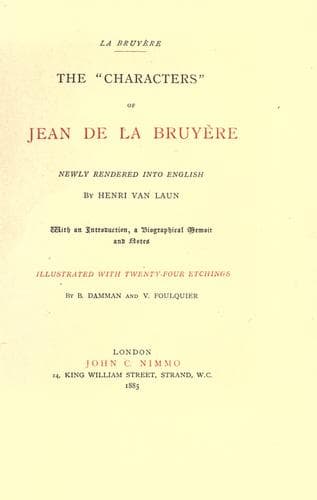
The "Characters" of Jean de La BruyèreLa Bruyère, Jean de
General
The "Characters" of Jean de La Bruyère
La Bruyère, Jean de
Character sketches -- Early works to 1800; Characters and characteristics
[136] The man of learning is Mabillon (1632-1707), a scholarly
Benedictine, and author of _De Re diplomatica_, _De Vetera analecta_,
and other works.
[137] The original has _homme de bien_. See page 43, note 2.
[138] Montaigne, Saint-Evremond, and the latest French writer on
Alexander, M. Jurien de la Gravière, happily still alive, and formerly
Minister for the French Navy, think more favourably than La Bruyère did
of the talents of the youthful king of Macedonia.
[139] Æmilius is the Prince de Condé (1621-1686). The whole of the
above paragraph is filled with reminiscences from Bossuetʼs _Oraison
funèbre du Prince de Condé_, delivered in the year 1687.
[140] The battle of Rocroi was won in 1643, when Condé was only
twenty-two years old, whilst those of Freiburg, Nordlingen, and Lens
were gained, respectively, in 1644, 1645, and 1648.
[141] An allusion to the siege of Lerida, raised by Condé in 1647.
[142] La Bruyère forgets the wars of the Fronde (1648-1653) and the
part Condé took in them, as well as in the wars of Spain against
France, from 1652 till 1659.
[143] His grandson and his nephew married illegitimate daughters of
Louis XIV.
[144] An allusion to his bad and hasty temper.
[145] La Bruyère adds in a note, “Sons and grandsons, descendants of
kings.” This seems a reminiscence of the Homeric Διογενῖς, Διοτρεφεῖς,
Βασιλεῖς.
[146] This compliment was addressed to the princes of the Condé family,
of whom one, the Prince de Conti (1629-1661), was in command of the
army in Catalonia, though he had never served. Compare the saying of
Mascarille in Molièreʼs _Les Précieuses Ridicules_: “People of quality
know everything without ever having learned anything.”
[147] Charles Castel, Abbé de Saint Pierre (1658-1743), a member of
the French Academy, whence he was ejected in 1718 on account of his
_Discours sur la Polysynodie_, a work in which he proposed a kind of
Constitution for the French nation.
[148] Celsus is the Baron de Breteuil, who was sent in 1682 on a
diplomatic mission to the dukes of Parma and Modena, but failed, and
was disowned.
[149] The “two brothers” are said to have been the counsellors of the
parliament, Claude and Michel le Peletier, and the quarrel was about a
question of precedence.
[150] The “two ministers” were Louvois and de Seignelay, a son of
Colbert, and the chief cause of their falling out seems to have been
the more or less assistance which should be given to James II. against
England.
[151] Menippus is the Marshal François de Villeroy (1644-1730), the
favourite of the king and of Mademoiselle de Maintenon, only known as
a perfect courtier when La Bruyère published his book, but who later
on proved himself an incapable general. In the _Mémoires_ of the Duke
de Saint-Simon, he is called _glorieux à lʼexcès par nature_. See also
page 43, note 1. Some commentators say Menippus was the Marquis de
Cavoye (1640-1716), one of the handsomest men and one of the greatest
duellists of the court.
Public-domain text, read in full here on John Shaqi.
Reviews
Reviews
No reviews yet
Be the first to share your thoughts on this work.
Elsewhere in the archive
Join the Discussion
Join the discussion
Sign in to leave a comment or review.
Sign InorCreate an account