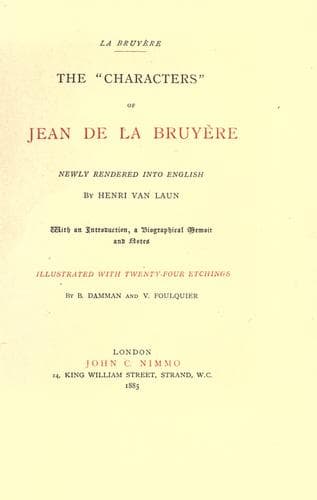
The "Characters" of Jean de La BruyèreLa Bruyère, Jean de
General
The "Characters" of Jean de La Bruyère
La Bruyère, Jean de
Character sketches -- Early works to 1800; Characters and characteristics
[178] “Most women have no characters at all,” says Pope in the Second
Epistle “Of the Characters of Women.” The late Rev. Whitwell Elwin
thinks this “a literal rendering” of La Bruyèreʼs § 65 “Of Men.” I
imagine it inspired by the above paragraph.
[179] To deceive some one is now in French _en imposer à quelquʼun_,
but until the last hundred years _imposer_ was used, which meant “to
deceive” and “to impose respect.”
[180] Glycera is said to have been Madame de la Ferrière, whom we have
already mentioned. See page 66, note.
[181] Pierre du Puget, lord of Montauron, who died in 1664, first
president of the _bureau des finances_ at Montauban, was celebrated for
his riches and vanity. P. Corneille dedicated his tragedy _Cinna_ to
him. Michael Particelli, lord of Esmery, became, through the patronage
of Cardinal Mazarin, _surintendant des finances_, and died in 1650.
[182] Venouse is not Venuzia, the native town of the Roman lyric poet
Horace, but Vincennes; the road from Paris to Vincennes was a favourite
spot for walking.
[183] The Faubourg Saint-Germain is meant by the “grand suburb.”
[184] Canidia, a Neapolitan lady, is said to have been loved by Horace,
and to have deserted him. Out of revenge the poet, in his _Epodes_ v.
and xvii., depicted her as an old sorceress who could unsphere the
moon. Canidia is supposed to allude to La Voisin, who was burned at the
stake in Paris, in 1680, for having poisoned several people.
[185] In the original _affranchi_, freedman.
[186] All the “Keys” say that “the husband” of this paragraph and the
following one was a certain Nicolas de Bauquemare, _président de la
deuxième chambre des requêtes au palais_.
[187] Wives of a similar kind seem to have been Madame de Montespan,
Madame de Sévigné, and Madame de la Fayette.
[188] This paragraph refers again to the _président_, mentioned on page
80, note 2, and to his wife, who was always called “DʼOns-en-Bray,”
pronounced “DʼOsembray,” after a property belonging to her husband.
[189] _Stupide_ had, in La Bruyères time, the meaning of “stupefied” as
well as of “stupid.”
[190] It might have been expected that some of the “Keys” would have
told us who Emira was, but this anecdote is either invented by La
Bruyère or founded on a fact only known to him.
[191] La Rouchefoucauld, in the _Maximes_ (1665), makes almost the same
remarks, and so does Pascal in the _Pensées_ (1670). It often happens
that those two authors agree in their expressions and thoughts with La
Bruyère, who carefully studied them before publishing his _Caractères_.
[192] _Discordia fit carior concordia_ is a saying of the Latin poet
Publius Syrus (104-41 B.C.)
[193] In the chapter “Of the Affections,” La Bruyère has borrowed a
goodly number of ideas of Senecaʼs treatise _De beneficiis_; this is
one of them.
[194] An imitation of another line of Publius Syrus: _Ita amicum
habeas, posse inimicum fieri ut putes_.
Public-domain text, read in full here on John Shaqi.
Reviews
Reviews
No reviews yet
Be the first to share your thoughts on this work.
Elsewhere in the archive
Join the Discussion
Join the discussion
Sign in to leave a comment or review.
Sign InorCreate an account