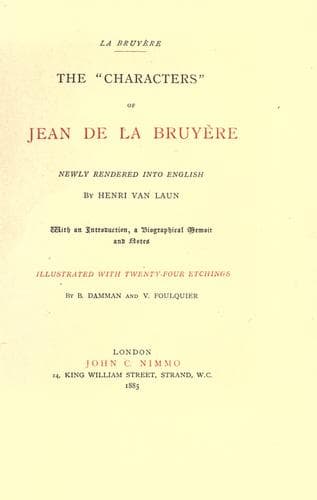
The "Characters" of Jean de La BruyèreLa Bruyère, Jean de
General
The "Characters" of Jean de La Bruyère
La Bruyère, Jean de
Character sketches -- Early works to 1800; Characters and characteristics
[166] The original has _questionnaire_, a word then already antiquated,
and which meant a man applying the _question_ or rack.
[167] Roscius seems to have been intended for a portrait of the
celebrated actor Michael Baron (1653-1729), whilst the names of Lelia,
Cesonia, Claudia, and Messalina probably allude to some of the ladies
of the court who intrigued with actors. During the eighteenth century
the names of the Maréchale de la Ferté, and of her sister the Countess
dʼOlonne (see page 61, note), both of very dissolute manners, were
mentioned as having been the originals of Claudia and Messalina, whilst
Claudia was also, according to some, a portrait of Marie-Anne Mancini,
Duchesse de Bouillon, though it is not probable that La Bruyère
intended to allude to her. Bathyllus and Cobus stand for Le Basque,
Pécourt, or Beauchamps, dancers at the Opera; Draco is Philibert, a
German flute-player of those times; Lelia or Cesonia are supposed to
have been a certain widow of the Marquis de Constantin.
[168] Is this not an allusion of our author to some nunneries not in
very good repute at the time?
[169] This applies, it is said, to the Maréchale de la Ferté, mentioned
on page 67, note 2, and to the Duke dʼAumontʼs second wife, who died in
1711, sixty-one years old.
[170] At the time La Bruyère wrote, nearly every fashionable lady had,
besides her father-confessor, a spiritual director, who was her “guide,
philosopher, and friend.” Boileau, in his tenth satire, says:—
“Mais de tous les mortels, grâce aux dévotes âmes,
Nul nʼest si bien soigné quʼun directeur de femmes.”
[171] _Placer des domestiques_, in the original; _domestique_ was used
for any person belonging to the household of some great nobleman, even
if he were himself a noble; it also meant “a household.”
[172] A note of La Bruyère says that this refers to “assumed piety.”
[173] Those ladies are supposed to have been the Duchesse dʼAumont,
already mentioned; the Countess de Lyonne, the wife of a minister of
state; the Duchess de Lesdiguières, and the Countess de Roucy.
[174] Our authorʼs note says, “A pretended pious woman.”
[175] It was then the custom for people who had a lawsuit to go and
solicit their judges in person.
[176] In La Bruyèreʼs time many ladies had a great reputation for
learning, such as Madame de Sévigné, and her daughter, Madame de
Grignan, who greatly admired Descartesʼ philosophy; Madame de la
Fayette; and a sister of Madame de Montespan, who was Abbess of
Fontévrault. Montaigne was of opinion that women had no need of
learning, and Molière, in his _Femmes Savantes_, holds the golden mean.
[177] Such were, for example, the heroines of the Fronde, who only
cared for ambition. Saint Simon in his _Mémoires_ speaks of the
Maréchale de Ciérambault, “who only left off gambling whilst at meals;”
the Princess de Harcourt, who took usually the sacrament after having
gambled until four in the morning; and the Duchesse dʼAumont, whom we
have already mentioned.
Public-domain text, read in full here on John Shaqi.
Reviews
Reviews
No reviews yet
Be the first to share your thoughts on this work.
Elsewhere in the archive
Join the Discussion
Join the discussion
Sign in to leave a comment or review.
Sign InorCreate an account