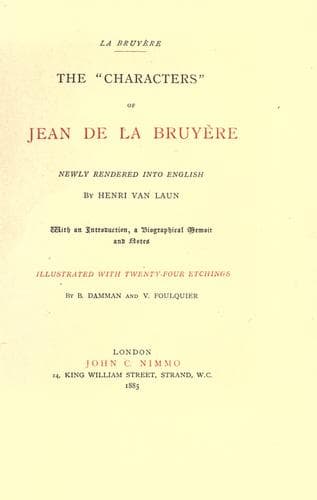
The "Characters" of Jean de La BruyèreLa Bruyère, Jean de
General
The "Characters" of Jean de La Bruyère
La Bruyère, Jean de
Character sketches -- Early works to 1800; Characters and characteristics
[227] This is an allusion to the society of the Hotel de Rambouillet
and to the so-called _précieuses_.
[228] It is generally supposed that here Isaac de Benserade (1612-1691)
is meant, who was pre-eminently a court poet, and wrote a great deal of
namby-pamby poetry, now deservedly forgotten. His “Character” appeared
for the first time in the sixth edition of La Bruyèreʼs work, only a
few months before his death, when he was seventy-eight years old.
[229] Our author draws a distinction between gentlemen in town and
at court, though he mentions those in town first. The silly novels
he attacks were those of Gomberville (1600-1647), of La Calprenède
(1610-1663), and above all those of Mdlle. de Scudéri (1607-1701), one
of the _précieuses_ of the Hotel de Rambouillet, and author of the
_Grand Cyrus_ (1650), _Clélie_ (1665), and of many other works.
[230] It seems to have escaped all commentators of La Bruyère that in
his time it was the fashion for the ladies at court to call a spade a
spade with a vengeance, and to use very plain and realistic language,
whilst the “city ladies” were not quite so daring; moreover, some of
the streets, squares, etc., of Paris had very peculiar names, quite
unfit for the mouth of any modest woman.
[231] By “silly things,” our author means “plays on words” called in
his time _équivoques_ or _turlupinades_.
[232] Marcus Annæus Lucanus, a Latin poet, who died in the year 65, was
put to death for his share in Pisoʼs conspiracy, at the early age of
twenty-seven.
[233] Claudus Claudianus (365-408), a Latin poet.
[234] L. Annæus Seneca, a stoic philosopher, and tutor to Nero, was
also put to death in the year 65 by order of his former pupil.
[235] Hermagoras is, according to all commentators, Paul Perron, a
learned Benedictine, and author of _LʼAntiquité des temps rétablie_,
etc. The old English translations name, however, also Isaac Vossius
(1618-1688), an able Dutch philologist, and a well-known French
literary man, Urbain Chevreau (1613-1701).
[236] In 1687, when this paragraph was first published, there was no
longer an independent kingdom of Hungary, for three years before the
crown had been declared hereditary in the House of Austria, which had
ruled Bohemia as well since 1525.
[237] These wars, interrupted by the peace of Nymeguen (1678), were
going on whilst our author wrote.
[238] Henri IV. (1553-1610), or _Henri le Grand_, according to La
Bruyèreʼs own note, was not the son of the last of the Valois, Henri
III. (1551-1589), but after the latterʼs death became heir to the
French throne, because Henry IV.ʼs father, Antoine de Bourbon, was
descended from the Count de Clermont, the fifth son of Louis IX.
[239] Those names La Bruyère found in the _Histoire du Monde_ of
Chevreau (see page 124, note 5); and nearly all of them are so wrongly
spelt that it is almost hopeless to discover whom they meant.
Public-domain text, read in full here on John Shaqi.
Reviews
Reviews
No reviews yet
Be the first to share your thoughts on this work.
Elsewhere in the archive
Join the Discussion
Join the discussion
Sign in to leave a comment or review.
Sign InorCreate an account