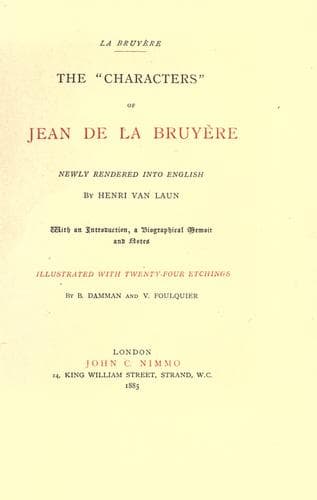
The "Characters" of Jean de La BruyèreLa Bruyère, Jean de
General
The "Characters" of Jean de La Bruyère
La Bruyère, Jean de
Character sketches -- Early works to 1800; Characters and characteristics
[240] In the month of December of the same year this paragraph had been
published, Joseph I. (1678-1711), emperor of the Romans, was crowned
king of Hungary, in virtue of his hereditary right. See page 215, note
1.
[241] Ninus was the husband of Semiramis, about 2182 B.C., and founded
with her Nineveh, of which empire she became queen; she abdicated after
a reign of forty-two years in favour of her son Ninyas. All these
persons seem, however, to have been mythological, and to have had no
foundation in history. The Semiramis of Herodotus lived 810-781 B.C.
[242] The passage in Josephus containing Manethosʼ tradition says,
“Mesphratuthmosis drove the Hyksos [or shepherd kings] as far as Avaris
[San in Egypt], and shut them up in it. His son Tuthmosis obliged them
to evacuate it.” Tuthmosis is really Aahmes, the founder of the 18th
dynasty, who drove the shepherd kings out of Egypt. Misphratuthmosis,
sometimes written Misphramuthosis, and Alisphragmuthosis, his relative
or ancestor, is meant by this name Alipharmutosis, but he has not been
recognised in Egyptian records.
[243] Sesostris is the Greek name of the conqueror Rameses II., the
third king of the 19th Egyptian dynasty.
[244] Artaxerxes Longimanus, king of Persia, succeeded his father
Xerxes I., 465 B.C., and died about 425 B. C.
[245] Cydias is Fontenelle (see page 11, note 1), who was only
thirty-seven years old when this paragraph was first printed in
the eighth edition of the “Characters,” in 1694, and who became La
Bruyèreʼs enemy ever since.
[246] Fontenelle had written for his uncle Thos. Corneille (1625-1709)
certain parts of two operas, _Psyché_ (1678) and _Bellérophon_ (1679);
for Beauval, in prose, an eulogy on Perrault (1688), and for a certain
Mdlle. Bernard, part of a tragedy of _Brutus_ (1691).
[247] Lucianus of Samosata, a satirist and a rhetorician (120-200 A.D.)
[248] The author adds “a philosopher and a tragic poet.” See page 124,
note 4.
[249] Plato, the well-known Greek philosopher (430-347 B.C.)
[250] Publius Virgilius Maro, the Roman epic and bucolic poet (70-19
B.C.)
[251] Theocritus, a Greek bucolic poet, who flourished about 272 B.C.
Fontenelle had written Dialogues of the dead, as Lucianus had done;
philosophical works and tragedies like Seneca, philosophical dialogues
in Platoʼs style, and pastoral poetry like Virgil and Theocritus.
[252] Perrault, La Motte (1672-1731), De Visé (1640-1710), and others.
[253] This friend is supposed to have been La Motte.
[254] The right of presentation to nearly all offices at court, or
official positions, was publicly bought and sold in Louis XIV.ʼs time.
[255] Commentators, who see allusions everywhere, suppose the “very
rich man” was Louvois, whose sons-in-law were the Dukes de la
Rocheguyon and de Villeneuve; or Colbert, who became the father-in-law
of the Dukes de Chevreuse, de Beauvilliers, and de Mortemart; or,
finally, Frémont, keeper of the royal treasury, who married his
daughter to the Duke de Lorges.
Public-domain text, read in full here on John Shaqi.
Reviews
Reviews
No reviews yet
Be the first to share your thoughts on this work.
Elsewhere in the archive
Join the Discussion
Join the discussion
Sign in to leave a comment or review.
Sign InorCreate an account