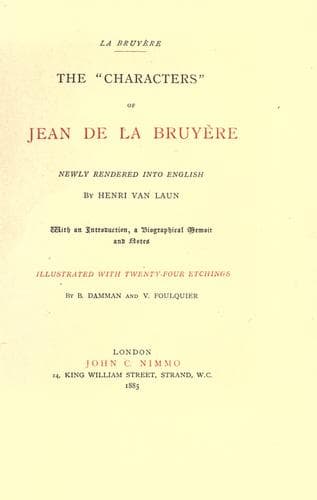
The "Characters" of Jean de La BruyèreLa Bruyère, Jean de
General
The "Characters" of Jean de La Bruyère
La Bruyère, Jean de
Character sketches -- Early works to 1800; Characters and characteristics
(74.) Hermagoras[235] knows not who is king of Hungary, and wonders
that no one talks about the king of Bohemia.[236] Speak not to him of
the wars in Flanders or in Holland,[237] or, at least, you must excuse
him from answering any questions about them; he mixes up all dates; he
neither knows when they began nor ended; battles and sieges are all
new to him; but he is very well read in the Titansʼ war, and can tell
you its progress and the most trifling details; nothing has escaped
him; he unravels in the same way the horrible chaos of the Babylonian
and Assyrian monarchies; he knows intimately the Egyptians and their
dynasties. He never saw Versailles, nor ever will; but he has almost
seen the tower of Babel, and counted its steps; he has found out
how many architects were employed about that building, and even has
their names at his fingersʼ ends. He believes Henri IV. to be a son
of Henri III.,[238] and neglects to know anything about the reigning
houses of France, Austria, and Bavaria. He asks what is the use of
studying such trifles; but he can quote to you all the kings of Media
and Babylon, and the names of Apronal, Herigebal, Noesnemordach, and
Mardokampad[239] are to him as familiar as those of Valois and Bourbon
are to us. He has yet to learn that the Emperor[240] is married, but he
can tell you that Ninus[241] had two wives. He hears the king enjoys
perfect health, and this reminds him that Thetmosis, a king of Egypt,
was a valetudinarian, and that he inherited this disposition from his
grandfather, Alipharmutosis.[242] What does he not know? What in all
venerable antiquity is hid from him? He will tell you that Semiramis,
or, as some call her, Serimaris, spoke so much like her son Ninyas,
that their voices could not be distinguished from one another; but he
dare not decide whether the mother had a manly voice like her son, or
the son an effeminate voice like his mother; he will confide to you
that Nimrod was left-handed, and Sesostris[243] ambidexter; that it is
an error to imagine one of the Artaxerxes was called Longimanus[244]
because his arms reached down to his knees, and not because one of his
hands was longer than the other; he adds that though some grave authors
affirm that it was his right hand, he has good grounds to maintain it
was the left hand.
Public-domain text, read in full here on John Shaqi.
Reviews
Reviews
No reviews yet
Be the first to share your thoughts on this work.
Elsewhere in the archive
Join the Discussion
Join the discussion
Sign in to leave a comment or review.
Sign InorCreate an account