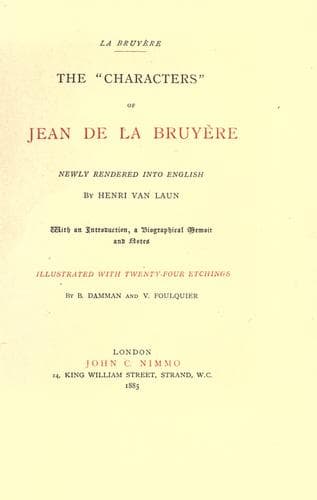
The "Characters" of Jean de La BruyèreLa Bruyère, Jean de
General
The "Characters" of Jean de La Bruyère
La Bruyère, Jean de
Character sketches -- Early works to 1800; Characters and characteristics
(75.) Ascanius is a sculptor, Hegio an iron-founder, Æschines a fuller,
and Cydias a wit,[245] for that is his trade. He has a signboard, a
shop, work that is ordered,[246] and journeymen who work under him;
he cannot possibly let you have those stanzas he has promised you in
less than a month, unless he breaks his word with Dosithea, who has
engaged him to write an elegy; he has also an idyl on the loom which
is for Crantor, who presses him for it, and has promised him a liberal
reward. You can have whatever you like—prose or verse, for he is just
as good in one as in the other. If you want a letter of condolence,
or one on some personʼs absence, he will write them; he has them even
ready made; step into his warehouse, and you may pick and choose.
Cydias has a friend who has nothing else to do but to promise to
certain people a long time beforehand that he will come to them, and
who, finally, introduces him in some society as a man seldom to be met
with, and exquisite in conversation. Then, just as a vocalist sings
or as a lute-player touches his instrument in a company where it has
been expected, Cydias, after having coughed, puts back his ruffles,
extends his hand, opens his fingers, and very gravely utters his
over-refined thoughts and his sophisticated arguments. Unlike those
persons whose principles agree, and who know that reason and truth
are one and the same thing, and snatch the words out of one anotherʼs
mouths to acquiesce in one anotherʼs sentiments, he never opens his
mouth but to contradict: “I think,” he says graciously, “it is just
the opposite of what you say;” or, “I am not at all of your opinion,”
or else, “Formerly I was under the same delusion as you are now; but,
...” and then he continues, “There are three things to be considered,”
to which he adds a fourth. He is an insipid chatterer; no sooner has he
obtained a footing into any society, than he looks out for some ladies
whom he can fascinate, before whom he can set forth his wit or his
philosophy, and produce his rare conceptions; for, whether he speaks
or writes, he ought never to be suspected of saying what is true or
false, sensible or ridiculous; his only care is not to express the same
sentiments as some one else, and to differ from everybody. Therefore,
in conversation, he often waits till every one has given his opinion
on some casual subject, or one which not seldom he has introduced
himself, in order to utter dogmatically things which are perfectly
new, but which he thinks decisive and unanswerable. “Lucianus[247] and
Seneca,”[248] says Cydias, “come pretty near me; but as for Plato,[249]
Virgil,[250] and Theocritus[251] they are quite below me,” and his
flatterer takes care to confirm him every morning in this opinion. As
Cydias has the same taste and interest as the revilers of Homer,[252]
he quietly expects that mankind will be undeceived and prefer modern
poets to the blind bard; then he will put himself at the head of these
Public-domain text, read in full here on John Shaqi.
Reviews
Reviews
No reviews yet
Be the first to share your thoughts on this work.
Elsewhere in the archive
Join the Discussion
Join the discussion
Sign in to leave a comment or review.
Sign InorCreate an account