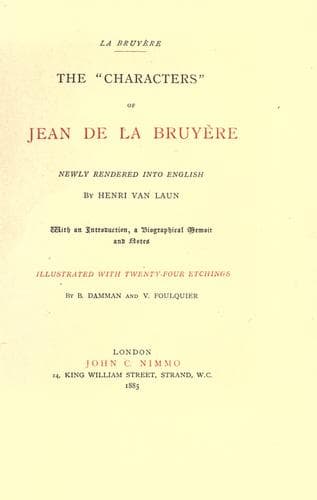
The "Characters" of Jean de La BruyèreLa Bruyère, Jean de
General
The "Characters" of Jean de La Bruyère
La Bruyère, Jean de
Character sketches -- Early works to 1800; Characters and characteristics
poets, and reserve the second place for a friend.[253] He is, in a
word, a compound of pedantry and formality, to be admired by cits and
rustics, in whom, nevertheless, there is nothing great except the
opinion he has of himself.
(76.) Profound ignorance makes a man dogmatical; he who knows nothing
thinks he can teach others what he just now has learned himself;
whilst he who knows a great deal can scarcely imagine any one should
be unacquainted with what he says, and, therefore, speaks with more
indifference.
(77.) Great things only require to be simply told, for they are spoiled
by emphasis; but little things should be clothed in lofty language,
as they are only kept up by expression, tone of voice, and style of
delivery.
(78.) I think we generally say things more delicately than we write
them.
(79.) Hardly any other men but born gentlemen or men of culture are
capable of keeping a secret.
(80.) All confidence placed in another is dangerous if it is not
perfect, for on almost all occasions we ought to tell everything or to
conceal everything. We have already told too much of our secret, if one
single circumstance is to be kept back.
(81.) Some men promise to keep your secret and yet reveal it without
knowing they are doing so; they do not wag their lips, and yet they
are understood; it is read on their brow and in their eyes; it is seen
through their breast; they are transparent. Other men do not exactly
tell a thing that has been intrusted to them, but they talk and act in
such a manner that people discover it for themselves. Lastly, there are
some who despise your secret, of whatever importance it may be: “it is
something mysterious which such-a-one has imparted to me and forbade me
to mention it,” and then out it comes.
If a secret is revealed, the person who has confided it to another is
to be blamed.
(82.) Nicander converses with Eliza about the gentle and courteous
way in which he lived with his wife from the day of their marriage to
the hour of her death; he had already said how sorry he was he had no
children by her, and he now repeats it; he talks of the houses he has
in town, and then of an estate he has in the country; he calculates
what it brings him in, draws a plan of the buildings, describes its
situation, expatiates on the conveniency of the apartments as well as
on the richness and elegance of the furniture; he assures her he loves
good cheer and fine horses and carriages, and complains that his late
wife did not care much for play and company. “You are so wealthy,”
said one of his friends to him, “why do you not buy some official
post,[254] or why not a certain piece of ground which would enlarge
your estate?” “People think I am richer than I really am,” replies
Nicander. He neither forgets his birth nor his relatives, and speaks of
his cousin, the superintendent of finances, or of his kinswoman, the
Lord Chancellorʼs wife. He informs
Public-domain text, read in full here on John Shaqi.
Reviews
Reviews
No reviews yet
Be the first to share your thoughts on this work.
Elsewhere in the archive
Join the Discussion
Join the discussion
Sign in to leave a comment or review.
Sign InorCreate an account