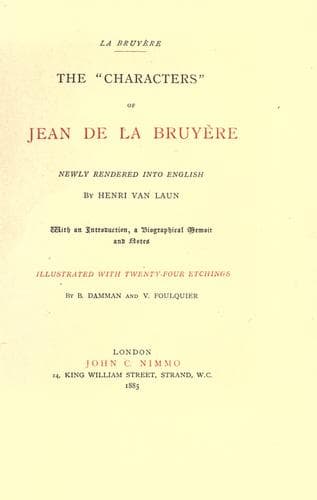
The "Characters" of Jean de La BruyèreLa Bruyère, Jean de
General
The "Characters" of Jean de La Bruyère
La Bruyère, Jean de
Character sketches -- Early works to 1800; Characters and characteristics
(18.) Champagne,[272] rising from a prolonged dinner, quite gorged, and
his head full of the agreeable fumes of Avenay or Sillery,[273] signs
an order for a tax to be levied which would have produced a famine in
a whole province, if other means had not been taken. He is excusable;
for how can a man whose digestion is just beginning understand that
people could anywhere die of starvation.
(19.) Sylvanus[274] has with his money bought rank and another name;
he is lord of the same manor where his forefathers had been paying the
_taille_;[275] formerly he was not good enough to be Cleobulusʼ page,
but now he is his son-in-law?
(20.) Dorus[276] is carried in a litter along the Appian Way;[277] his
freedmen and slaves run before him to clear the way and to turn aside
the people; he wants nothing but Lictors;[278] he enters Rome with
quite a retinue, a triumphant foil to the meanness and poverty of his
father Sanga.
(21.) No one makes a better use of his fortune than Periander;[279] it
gives him a certain rank, influence, and authority; people no longer
ask him to be their friend, but they implore his protection. In the
beginning he spoke of himself as “such a man as I am,” but soon he
says “a man of my rank;” for he pretends to be one of these men, and
there are none who borrow money of him, or eat his dinners, which are
exquisite, who dare dispute it. His residence is splendid; the outside
is Doric, and there is no gate but a portico. Is it a private house
or a temple? People are at a loss to know which. He is lord paramount
of the entire precincts; every one envies him, and would rejoice at
his downfall; his wifeʼs pearl necklace has made all the ladies of the
neighbourhood her enemies. Everything in him is of a piece, and nothing
yet belies that grandeur he has acquired, for which he has paid and
does not owe anything. But why did his old and feeble father not die
twenty years ago before Perianderʼs name was ever mentioned? How can
any man ever endure those odious invitations to a funeral[280] which
always reveal the real origin of the deceased, and often put the widows
or the heirs to the blush? How shall he hide them from the eyes of the
envious, malicious, keen-sighted town, and offend a thousand people
who will insist on taking their due places at all funerals? Besides,
what would you have him do? Shall he style his father _Noble homme_ and
perhaps _Honorable homme_, whilst he himself is dubbed _Messire_?[281]
(22.) How many men are like trees, already strong and full grown, which
are transplanted into some gardens, to the astonishment of those people
who behold them in these fine spots, where they never saw them grow,
and who neither know their beginning nor their progress!
(23.) If some dead were to rise again and saw who bore their
illustrious names, and that their ancient lands, their castles, and
their venerable seats were owned by the very men whose fathers had
perhaps been their tenants, what would they think of our age?
Public-domain text, read in full here on John Shaqi.
Reviews
Reviews
No reviews yet
Be the first to share your thoughts on this work.
Elsewhere in the archive
Join the Discussion
Join the discussion
Sign in to leave a comment or review.
Sign InorCreate an account