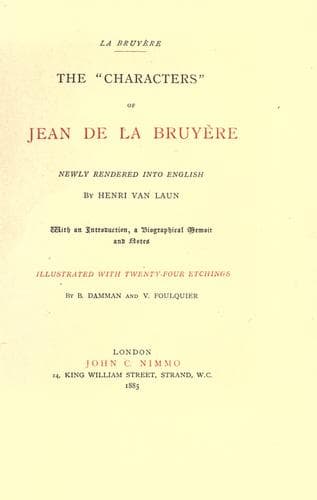
The "Characters" of Jean de La BruyèreLa Bruyère, Jean de
General
The "Characters" of Jean de La Bruyère
La Bruyère, Jean de
Character sketches -- Early works to 1800; Characters and characteristics
(24.) Nothing makes us better understand what trifling things
Providence thinks He bestows on men in granting them wealth, money,
dignities, and other advantages, than the manner in which they are
distributed and the kind of men who have the largest share.
(25.) If you were to enter a kitchen, where all that art and method can
do is employed to gratify your palate, and make you eat more than you
want; if you see how the viands are prepared which will be served up
at the feast; if you observe how they are manipulated, and the various
modifications they undergo before they become first-rate dishes, and
are brought to that neatness and elegance which charm your eyes, puzzle
your choice, and make you decide to taste them all; and then saw the
ingredients of this feast anywhere else than on a well-spread table,
how offended and disgusted you would be! If you were to go behind the
scenes, and count the weights, the wheels, the ropes in “flights” and
in the machinery; if you were to consider how many men are employed in
executing these movements, and how they ply their arms and strain their
nerves, you would ask if these are the prime motors and mainsprings of
so handsome and natural a spectacle, which seems so full of life and so
intuitive, and you would be greatly astonished at such efforts and such
energy. In like manner inquire not too narrowly into the origin of the
fortune of any farmer of the revenue.
(26.) This youth,[282] so ruddy, so florid, and so redolent of health,
is lord of an abbey and of ten other benefices; they bring him in
altogether one hundred and twenty thousand[283] _livres_ a year, which
are paid him in golden coin.[284] Elsewhere there are a hundred and
twenty indigent families who have no fire to warm themselves during
winter, no clothes to cover themselves, and who are often wanting
bread; they are in a wretched and piteous state of poverty. What an
inequality? And does this not clearly prove that there must be a future
state?
(27.) Chrysippus,[285] an upstart, and the first nobleman of his
lineage, thirty years ago limited his aims to two thousand _livres_
a year; this was the height of his desires and the summit of his
ambition; at least he said so, as many still remember. Some time
after, I do not know by what means, he was able to give to one of his
daughters as her dowry as much money as he thought formerly an ample
competency for his whole lifetime. A like sum is put away for each of
his other children, and he has a good many of them; and this is only an
advance of their share in his estate, for a good deal of wealth may be
expected at his death. He is still alive, and though advanced in years,
employs the few days which still remain to him in labouring to become
richer.
Public-domain text, read in full here on John Shaqi.
Reviews
Reviews
No reviews yet
Be the first to share your thoughts on this work.
Elsewhere in the archive
Join the Discussion
Join the discussion
Sign in to leave a comment or review.
Sign InorCreate an account