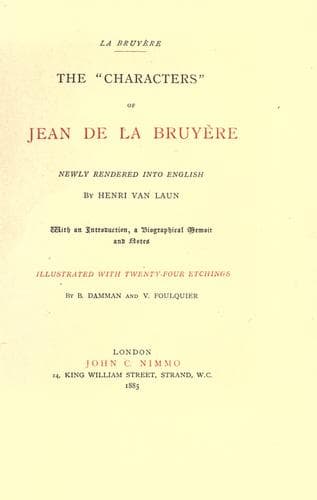
The "Characters" of Jean de La BruyèreLa Bruyère, Jean de
General
The "Characters" of Jean de La Bruyère
La Bruyère, Jean de
Character sketches -- Early works to 1800; Characters and characteristics
(59.) Let us first except those noble and courageous minds, if there
are any yet on this earth, who assist those who are in want, contrive
to do good, whom no necessities, nor inequality of rank or fortune,
nor intrigues can separate from those they have once chosen for their
friends; and after having made this remark, let us boldly state a
lamentable truth, which makes us miserable to think about, namely, that
there is not a person in this world, however intimately connected with
us by social ties or by friendship, who likes us, enjoys our society,
has a great many times offered us his services, and sometimes even
rendered us one, who, when swayed by his own interests, would not feel
inwardly disposed to break with us and become our enemy.
(60.) Whilst Orontes[301] is increasing in years, in wealth, and in
income, a girl born in a certain family flourishes, grows up, becomes
very handsome, and enters on her sixteenth year. Orontes, who is then
fifty, of inferior birth, without intelligence and the smallest merit,
has to be entreated to marry that young, handsome, and witty girl, and
is preferred to all his rivals.
(61.) Marriage, which ought to be a source of all felicity, is often
to a man a heavy burden which crushes him through want of fortune. For
his wifeʼs and childrenʼs sake he is sorely tempted to commit fraud,
to tell falsehoods, and obtain illicit gains. It must be a dreadful
situation for any man to have to choose between roguery and indigence.
To marry a widow means, in plain language,[302] to make oneʼs fortune,
though this is not always the case.[303]
(62.) A man who has only inherited sufficient money to live comfortably
as a lawyer wishes presently to become an official, then a magistrate,
and finally a judge.[304] Thus it is with all ranks and conditions of
men straitened or limited in their means, who, after having attempted
several things beyond their power, force, if I may say so, their
destiny; they have neither sense enough to forbear being rich nor to
continue rich.
(63.) Dine comfortably, Clearchus,[305] make a good supper, put some
wood on the fire, buy a cloak, put hangings all round your room, for
you have no love for your heir; you even do not know him; you have not
got any.
(64.) When we are young we lay up for old age; when we are old we save
for death; a prodigal heir first gives us a splendid funeral, and then
lavishes whatever money is left to him.
(65.) After his death a miser spends more money in one day than he
spent in ten years when he was alive; and his heir more in ten months
than the miser could find in his heart to part with during his whole
lifetime.[306]
(66.) When we lavish our money we rob our heir; when we merely save it
we rob ourselves. The middle course is to be just to ourselves and to
others.
(67.) Children, perhaps, would be dearer to their parents and parents
to their children, were it not for the latter being their heirs.
Public-domain text, read in full here on John Shaqi.
Reviews
Reviews
No reviews yet
Be the first to share your thoughts on this work.
Elsewhere in the archive
Join the Discussion
Join the discussion
Sign in to leave a comment or review.
Sign InorCreate an account