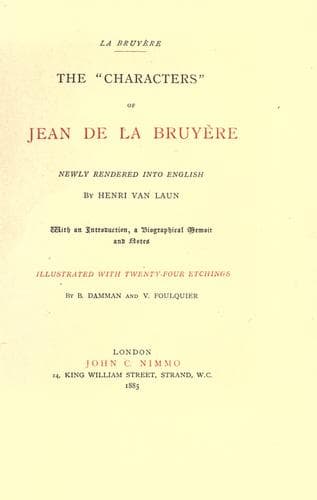
The "Characters" of Jean de La BruyèreLa Bruyère, Jean de
General
The "Characters" of Jean de La Bruyère
La Bruyère, Jean de
Character sketches -- Early works to 1800; Characters and characteristics
(74.) I am not surprised that there are gambling houses, like so many
snares laid for human avarice; like abysses where many a manʼs money is
engulphed and swallowed up without any hope of return; like frightful
rocks against which the gamblers are thrown and perish; that certain
men are sent forth to find out the precise time some person has landed
with newly got prize-money, or who has gained a lawsuit which has
brought him in a goodly sum, or who has received some presents, or who
has had a very lucky run at play; what young man of family has just
come into a large inheritance, or what desperate clerk will venture
the monies of his office on the turn of a card. Truly cheating is
villainous and rascally, but it is an old and well-known trade, and
practised at all times by the men we call professional gamblers. They
have a sign outside their doors, and this may be the inscription: “Here
cheating is done fairly;” for I suppose they do not pretend to be
blameless. Every one knows that if a man gambles in one of these houses
he is certain to lose. What to me is unaccountable, is that there
should always be as many fools as gamblers want, to make a living by
them.
(75.) Thousands have been ruined by gambling, and yet they tell you
very coolly they cannot do without it. What an idle excuse is this!
Is there any violent and shameful passion in existence to which we
cannot apply the same language? Would any one be allowed to say, he
cannot live without stealing, murdering, or rushing into all kinds of
excesses? It is allowable to gamble in a frightful manner, without
intermission, shame, or limit; to have no other aim but the total ruin
of your adversary; to be carried away by a desire for gain, thrown into
despair by losing or consumed by avarice; to risk on the turn of a card
or die your own future and that of your wife and children; or should we
do without it yet? And are there not sometimes worse consequences than
these at the gambling-table, when men are entirely stripped, obliged
to do without clothes and food, and cannot provide these for their
families?
I allow no one to be a knave, but I will allow a knave to play high,
but not an honest man, for it is too silly to expose oneself to a heavy
loss.[312]
(76.) There is but one sorrow which is lasting, and that is one
produced by the loss of property; time, which alleviates all others,
sharpens this; we feel it every moment during the course of our lives
when we miss the fortune we have lost.
(77.) The man who spends his fortune without marrying his daughters,
paying his debts, or lending it out on good security, may be well
enough liked by every one except by his wife and children.
Public-domain text, read in full here on John Shaqi.
Reviews
Reviews
No reviews yet
Be the first to share your thoughts on this work.
Elsewhere in the archive
Join the Discussion
Join the discussion
Sign in to leave a comment or review.
Sign InorCreate an account