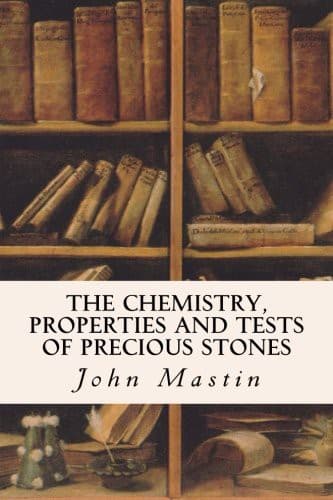
The chemistry, properties and tests of precious stones — John Shaqi
The chemistry, properties and tests of precious stonesMastin, John
Science
The chemistry, properties and tests of precious stones
Mastin, John
Precious stones
It is also interesting to note that if the tourmaline is not warmed so
high as to reach a temperature of 50 deg. F., or is heated so strongly as to
exceed more than a few degrees above 300 deg. F., then these magnetic
properties do not appear, as no polarity is present. This polarity, or
the presence of positive and negative electricity in one stone, may be
strikingly illustrated in a very simple manner:--If a little sulphur and
red-lead, both in fine powder, are shaken up together in a paper or
similar bag, the moderate friction of particle against particle
electrifies both; one negatively, the other positively. If, then, a
little of this now golden-coloured mixture is gently dusted over the
surface of the tourmaline or other stone possessing electric polarity, a
most interesting change is at once apparent. The red-lead separates
itself from the sulphur and adheres to the negative portion of the
stone, whilst the separated sulphur is at once attracted to the positive
end, so that the golden-coloured mixture becomes slowly transformed into
its two separate components--the brilliant yellow sulphur, and the
equally brilliant red-lead. These particles form in lines and waves
around the respective poles in beautiful symmetry, their positions
corresponding with the directions of the lines of magnetic force,
exactly as will iron filings round the two poles of a magnet.
From this it will clearly be seen how simple a matter it is to isolate
the topaz, tourmaline, and all the pyro-electric stones from the
non-pyro-electric, for science has not as yet been able to give to
spurious stones these same electric properties, however excellent some
imitations may be in other respects. Further, almost all minerals lose
their electricity rapidly on exposure to atmospheric influences, even to
dry air; the diamond retains it somewhat longer than most stones, though
the sapphire, topaz, and a few others retain it almost as long again as
the diamond, and these electric properties are some of the tests which
are used in the examination of precious stones.
Those stones which show electricity on the application of pressure are
such as the fluorspar, calcite, and topaz.
With regard to magnetism, the actual cause of this is not yet known with
certainty. It is, of course, a self-evident fact that the magnetic iron
ore, which is a form of peroxide, commonly known as magnetite, or
lodestone, has the power of attracting a magnet when swinging free, or
of being attracted by a magnet, to account for which many plausible
reasons have been advanced. Perhaps the most reasonable and acceptable
of these is that this material contains molecules which have half their
substance positively and the other half negatively magnetised.
Public-domain text, read in full here on John Shaqi.
Reviews
Reviews
No reviews yet
Be the first to share your thoughts on this work.
Join the Discussion
Join the discussion
Sign in to leave a comment or review.
Sign InorCreate an account