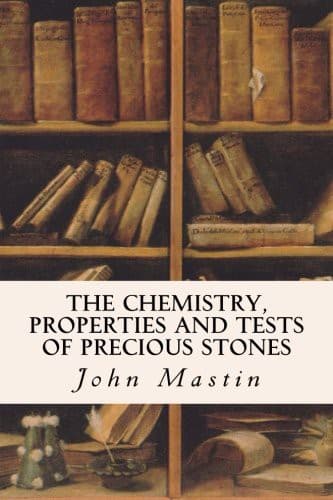
The chemistry, properties and tests of precious stones — John Shaqi
The chemistry, properties and tests of precious stonesMastin, John
Science
The chemistry, properties and tests of precious stones
Mastin, John
Precious stones
Turning to the silica series, we again find a number of gems with two
elements only, silica--an important constituent of the earth's
crust--and oxygen--an important constituent of atmospheric air. In this
group may be mentioned the opal, amethyst, agate, rock-crystal, and the
like, as the best known examples, whilst oxygen appears also mostly in
the form of oxides, in chrysoberyl, spinel, and the like. This silica
group is extremely interesting, for in it, with the exception of the
tourmaline and a few others, the composition of the gems is very simple,
and we find in this group such stones as the chrysolite, several
varieties of topaz, the garnet, emerald, etc., etc.
Malachite and similar stones are more ornamental than precious, though
they come in the category of precious stones. These are the carbonate
series, containing much carbonic acid, and, as may be expected, a
considerable proportion of water in their composition, which water can,
of course, be dispelled by the application of heat, but to the
destruction of the stone.
From all this will be seen how strong is the theory of aqueous
percolation, for, given time and pressure, water charged with
earth-crust constituents appears to be the origin of the formation of
all precious stones; and all the precious stones known have, when
analysed, been found to be almost exclusively composed of
upper-earth-crust constituents; the other compounds which certain stones
contain may, in all cases, be traced to their matrix, or to their
geological or mineralogical situation.
In contradistinction to this, the essentially underground liquids, with
time and pressure, form metallic minerals and mineralise the rocks,
instead of forming gems.
Thus we see that in a different class of minerals--compounds of metals
with the sulphates, such as sulphuric acid and compounds; also those
containing the metallic sulphides; in cases where the metalliferous ores
or the metallic elements enter into composition with the
halogens--bromine, chlorine, fluorine, and iodine--in all these,
precious stones are comparatively common, but the stones of these groups
are invariably those used for decorative or ornamental purposes, and
true "gems" are entirely absent.
It would therefore appear that though metallic minerals, as already
mentioned, are formed by the action of essentially _underground_
chemically-charged water--combined with ages of time and long-continued
pressure, rocks and earth being transformed into metalliferous ores by
the same means--precious stones (or that portion of them ranking as
jewels or gems) must on the contrary be wholly, or almost wholly,
composed of _upper_-earth-crust materials, carried deep down by water,
and subjected to the action of the same time and pressure; the simpler
the compound, the more perfect and important the result, as seen in the
diamond, the ruby, and the like.
CHAPTER III.
PHYSICAL PROPERTIES.
A--CRYSTALLINE STRUCTURE.
Public-domain text, read in full here on John Shaqi.
Reviews
Reviews
No reviews yet
Be the first to share your thoughts on this work.
Join the Discussion
Join the discussion
Sign in to leave a comment or review.
Sign InorCreate an account