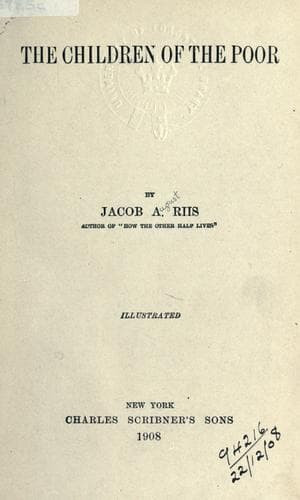
The Children of the PoorRiis, Jacob A. (Jacob August)
History
The Children of the Poor
Riis, Jacob A. (Jacob August)
Child welfare -- New York (State) -- New York; Poor; Poor -- New York (State) -- New York
That proviso cut the matter to the quick. The law declared the school to
be a "temporary home for dependent children, where they shall be detained
only until they can be placed in family homes." That is a very different
thing from the institution that, with its handsome buildings, its lawns,
and its gravelled walks, looks to the poor parent like a grand
boarding-school where his child can be kept, free of charge to him, and
taught on terms that seem alluringly like the privileges enjoyed by the
rich, until it shall be old enough to earn wages and help toward the
family support; very different from the plan of sending the boy to the
asylum to be managed, the moment parental authority fails at home. To what
extent these things are done in New York may be inferred from the
statement of the Superintendent of the Juvenile Asylum, which contains an
average of a thousand children, that three-fourths of the inmates could
not be sent to free homes in the West because their relatives would not
consent to their going.[30] It was only last summer that my attention was
attracted, while on a visit to this Juvenile Asylum, to a fine-looking
little fellow who seemed much above the average of the class in which I
found him. On inquiring as to the causes that had brought him to that
place, I was shocked to find that he was the son of a public official,
well-known to me, whose income from the city's treasury was sufficient not
only to provide for the support of his family, but to enable him to
gratify somewhat expensive private tastes as well. The boy had been there
two years, during which time the Asylum had drawn for his account from the
public funds about $240, at the per capita rate of $110 for each inmate
and his share of the school money. His father, when I asked him why the
boy was there, told me that it was because he would insist upon paying
unauthorized visits to his grandmother in the country. There was no
evidence that he was otherwise unmanageable. Seeing my surprise, he put
the question, as if that covered the ground: "Well, now! where would you
put him in a better place?" It was a handsome compliment to the Asylum,
which as a reform school it perhaps deserved; but it struck me, all the
same, that he could hardly have put him in a worse place, on all accounts.
Public-domain text, read in full here on John Shaqi.
Reviews
Reviews
No reviews yet
Be the first to share your thoughts on this work.
Elsewhere in the archive
Join the Discussion
Join the discussion
Sign in to leave a comment or review.
Sign InorCreate an account