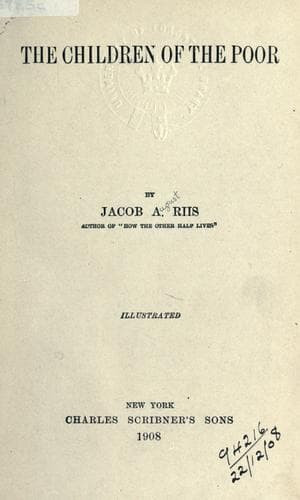
The Children of the PoorRiis, Jacob A. (Jacob August)
History
The Children of the Poor
Riis, Jacob A. (Jacob August)
Child welfare -- New York (State) -- New York; Poor; Poor -- New York (State) -- New York
I do not know how many such cases there were in the Asylum then. I hope
not many. But it is certain that our public institutions are full of
children who have parents amply able, but unwilling, to support them. From
time to time enough such cases crop out to show how common the practice
is. Reference to cases 59,703, 59,851, and 60,497 in the report of the
Society for the Prevention of Cruelty to Children (1892), will discover
some striking instances that were ferreted out by the Society's officers.
All of the offenders were in thriving business. One of them kept a store
in Newark--in another State--and was not even a resident of the city. He
merely "honored it with the privilege of paying his children's
boarding-school expenses in the institution." They were all Italians.
These people seem to consider that it is their right to thus feed at the
public crib. Perhaps it is the first quickening of the seed of municipal
politics that sprouts so energetically among them in the slums, under the
teaching of their Irish patrons.
When Mrs. Lowell inspected the New York City institutions in 1889, she
found "that of 20,384 individual children sheltered in them, 4,139 had
been that year returned to parents or friends, that is, to the persons who
had given them up to be paupers; that there were only 1,776 orphans among
them, and 4,987 half orphans, of whom 2,247 had living fathers, who
presumably ought to have been made to support their children themselves."
Three years later, the imperfect returns to a circular inquiry sent out by
the State Board of Charities, showed that of 18,556 children in
institutions in this State, 3,671, or less than twenty per cent., were
orphans. The rest then had, or should have, homes. Doubtless, many were
homes of which they were well rid; but all experience shows that there
must have been far too many of the kind that were well rid of _them_, and
to that extent the tax-payers were robbed and the parents and the children
pauperized. And that even that other kind were much better off in the long
run, their being in the institution did not guarantee. Children, once for
all, cannot be successfully reared in regiments within the narrow rules
and the confinement of an asylum, if success is to be measured by the
development of individual character. Power to regulate or shorten their
stay is not vested to any practical extent or purpose in any outside
agency. Within, with every benevolent desire to do the right, every
interest of the institution as a whole tends to confuse the perception of
it. The more children, the more money; the fewer children, the less money.
A thousand children can be more economically managed for $110,000 than
five hundred for half the money. The fortieth annual report of the
Juvenile Asylum (1891) puts it very plainly, in this statement on page 23:
"Until the capacity of the Asylum was materially increased, an annual
deficit ranging between $5,000 and $10,000 had to be covered by appeals to
Public-domain text, read in full here on John Shaqi.
Reviews
Reviews
No reviews yet
Be the first to share your thoughts on this work.
Elsewhere in the archive
Join the Discussion
Join the discussion
Sign in to leave a comment or review.
Sign InorCreate an account