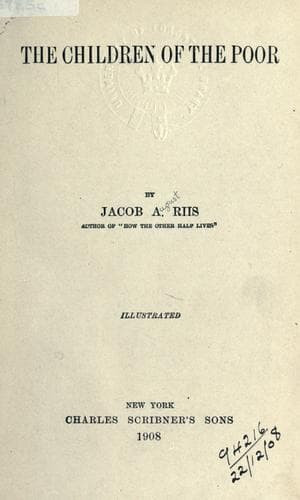
The Children of the PoorRiis, Jacob A. (Jacob August)
History
The Children of the Poor
Riis, Jacob A. (Jacob August)
Child welfare -- New York (State) -- New York; Poor; Poor -- New York (State) -- New York
"The testimony of two gentlemen on our Board of Council," they reported,
"both experienced as heads of great industrial enterprises, is that
institution boys are generally the least desirable apprentices. They have
been dulled in faculty, by not having been daily exercised in the use of
themselves in small ways; have marched in platoons; have done everything
in squads; have had all the particulars of life arranged for them; and, as
a consequence, they wait for someone else to arrange every piece of work,
and are never ready for emergencies, nor able to 'take hold.'" But when
they came to actually board the children out, all but the parents of nine
were suddenly able to take good care of them themselves, and of the rest
three found a way before final arrangements were made. There were seventy
children in the Home. Pauperism runs in the same ruts in New York as in
Pennsylvania, and the motive power is the same--ill-spent money.
CHAPTER XVI.
THE VERDICT OF THE POTTER'S FIELD
Looking back now over the field we have traversed, what is the verdict?
Are we going backward or forward? To be standing still would be to lose
ground. Nothing stands still in this community of ours, with its
ever-swelling population, least of all the problem of the children of the
poor. It got the start of our old indifference once, and we have had a
long and wearisome race of it, running it down.
But we have run it down. We are moving forward, and indifference will not
again trap us into defeat. Evidence is multiplying on every hand to show
that interest in the children is increasing. The personal service, that
counts for so infinitely much more than money, is more freely given day by
day, and no longer as a fashionable fad, but as a duty too long neglected.
From the colleges young men and women are going forth to study the problem
in a practical way that is full of promise. Charity is forgetting its
petty jealousies and learning the lesson of organization and co-operation.
"Looking back," writes the Secretary of the Charity Organization Society,
"over the progress of the last ten years, the success seems large, while
looking at our hopes and aims it often seems meagre." The Church is coming
up, no longer down, to its work among the poor. In the multiplication of
brotherhoods and sisterhoods, of societies of Christian Endeavor, of
King's Daughters, of efforts on every hand to reach the masses, the law of
love, the only law that has real power to protect the poor, is receiving
fresh illustration day by day.
The Fresh Air Work, the Boys' Clubs, the Society for the Prevention of
Cruelty to Children, bear witness to it, and to the energy and resources
that shall yet win the fight for us. They were born of New York's plight.
The whole world shares in the good they have wrought.
Public-domain text, read in full here on John Shaqi.
Reviews
Reviews
No reviews yet
Be the first to share your thoughts on this work.
Elsewhere in the archive
Join the Discussion
Join the discussion
Sign in to leave a comment or review.
Sign InorCreate an account